Here We Are, Friends.

Here We Are, Friends.

My time volunteering at the drop-in center was a little different this week. I talked to some of my buddies and made a few rounds greeting acquaintances, but the homeless and marginalized folks who come for coffee, food, and company weren’t, for the most part, concerned about what did or did not happen in the election. The words and impression I get are that they don’t have any party affiliation and don’t feel like who the President is has any tangible impact on their lives. It’s probably the only place I can go where a White guy wearing a Trump hat doesn’t scare or anger me. Politics is generally not a popular topic of conversation among community members.

But the volunteers are a different story. I spent most of the morning listening to, consoling, and freaking out with the wonderful septuagenarian and octogenarian White ladies I’ve been volunteering with for the past 2 1/2 years – a Sister, a former RN, and a former Social Worker who served the same population she volunteers with now. The nurse was particularly concerned about the prospect of RFK leading healthcare, the Social Worker about the LGBTQ community, and all of us about the poor, the homeless, the immigrants (including the beautiful Ecuadorian family that runs the kitchen, who suffered for months while their oldest son was held in immigration detention in a fucking prison in Louisiana, and who have finally felt a little stability), and, of course, democracy.

I rip on White women a lot. (It’s okay. I’m White.) For fuck’s sake, they voted for that misogynistic rapist AGAIN. But I love the ones who show up. I love these women. They haven’t been coming to the center – for Years – to grace the peons with their presence or foist lessons or morality upon anyone. They come to be with people, to talk, to listen, to humanize those who feel less than that, and to revitalize themselves as well. Their privilege doesn’t set them apart from the patrons, it increases the diversity of the whole group, of which they are absolutely a part. So we joke about being occasionally yelled at or called racist, and we mourn the loss of friends who didn’t make it through the night, and we worry about those who are particularly vulnerable, and get frustrated when they seem unwilling or unable to help themselves, and when the system fails them again and again, and we keep showing up.

I’ve been emotionally stable this week, which seems weird. I’m sure it sounds weird, too. I think I pre-grieved this potential outcome in my freak out a few weeks ago, (perhaps I’ll have my comeuppance, like Roman) Whatever the reason, I am so grateful to be, essentially, okay. For as long as it lasts. It allowed me to meet my students where they were at on Wednesday, to keep away from the fear and hatred on Facebook (no judgement, just observation), and to be present for these strong, loving, single women and everyone in our community today, whether with a coffee refill, a laugh, a movie recommendation, or a hug.

This is what I believe. Show up. Show up in your body with other bodies when you can. Show up wherever you can: in your family, in your neighborhood, in your workplace, in your spiritual center. Show up with a hello, a cookie, a conversation. This I can give. This I can control. I’m full of love right now. Wherever you’re at is fine, but I hope wherever it is, you can see a love & community from there.

Start Where You’re At: Mitt Romney?

Start Where You’re At: Mitt Romney?

Holy hell, it’s been hard to blog this year. I don’t know whether to blame the additional State Fair job, the suckiness of my regular job, the world as it is, or just the natural ebb & flow of being human, but the longer I’m away the harder it is to come back. Do I try to wow you with some heretofore hidden epiphany? Catch you up on my life? (yawn) List all of the spiritual accomplishments I’ve acquired in 2023? (ha!) Nah. Here’s what caught my attention today.

I pedaled over to the DMV this morning (they don’t call it the DMV in Minnesota, but fuck that: it’s the DMV) for a relatively painless Real ID appointment and plugged into Fresh Air’s interview with the author of Mitt Romney’s bio for the ride. Like many, I am intrigued with the recent revelations from the ageless Mormon, and have been mildly impressed with the integrity he’s maintained during his Senate terms. He has a family history of doing the right thing: as HUD Secretary, his father attempted to deny federal funding to communities that were de facto racially segregated, before Nixon shut him down (check out the This American Life segment if you want more on that). And voting for impeachment was impressive, especially considering the bodyguards he’s been personally paying for ever since.

Anyhoo, what my Buddhish perception found most intriguing about the interview was Romney’s bemusement over the self-imposed enslavement of most Senators to the US Senate. In his words, the chamber is “a club for old men” whose “psychic currency” as a human is built on the foundation of Being a US Senator. Not just that their job is important to them, but, for most of them, their identity is their job. The decisive question when making a vote is “will this help me get reelected?” He said he has tried to reason with them, to use himself as an example: that failing to win the Presidency as a major party nominee was about the biggest loss one could imagine, and he came out okay. But clearly, most of these guys are not like Romney. And many of these guys are not okay.

I’ve occasionally been confused by the contortions some Republicans have made to twist their lips onto Trump’s ass. I try not to assume that people are evil, so I look for motivation behind actions that are incomprehensible to me. Why even be an elected official if you don’t have issues or policies you care about? Why remain an elected official if you’ve caved on everything you purportedly did care about? Why play lackey to a narcissistic fool who would sell you out and put your life in jeopardy just to generate more likes on Twitter? You could probably make a lot more money in the private sector (especially once you’ve held office). And they don’t do it only because they fear actual retaliation – these spineless humanoids were selling out before Trump had the power to literally rally unhinged fans to attack them. In fact, it was the Republican party’s utter prostration to Trump that helped forge the mob of the unhinged that we’re all grappling with today. Is it just the lust for power? Maybe, but how much power do you actually have when a volatile, infantile, failed businessman controls your every move?

I think it’s something else. What Romney has that most of his old, White colleagues do not is an apparently real commitment to his form of morality, apparently from the Mormon church. It’s hard for me to believe that the guidance I receive from Buddhist practice & dharma is anything like the “spirituality” others glean from conservative religions, but I have to admit that my disbelief comes primarily from ignorance. There are countless fucked up things about the mainstream Mormon church (though far more about FLDS – hoo-boy!) but there does seem to be some idea of integrity built in, and clearly Romney’s religion and family stand outside of, preceded, and will supersede his role as a Senator. His sense of self is not chained to that, or any, title. Instead of getting an apartment in DC or living with other Congressmen, he bought a townhouse off the strip in the hopes his wife and kids would feel more comfortable visiting. What I’m trying to say in way too many words is that there is more to Mitt’s life than winning, and maybe if winning is all that matters to the once-and-oh-please-never-again-President, then caring less about winning, by converse illogic, is … good?

The bush I’m pummeling here is this: morality means something to Romney, something more than having power or winning an election. He believes that he has a higher obligation, and that has apparently kept him from caving like the others. This is a bit hard for me to say because it’s in pretty direct opposition to what I used to believe (as most things are these days – FU, Buddha!). When I used to hear that people were supporting candidates “of Faith” or because they were “right with the lord” or “Christians” I was always horrified. What does that have to do with policy? Don’t you want to know their positions? Isn’t that incredibly arrogant and presumptuous to think that someone will be a better leader just because they believe in your God? And while I still agree with most of that, I now understand the reasoning behind it. Well-meaning people may well believe that Christians – or Whatevers – will be better politicians because they will not be unduly swayed by what is convenient or popular or least risky – they will be guided predominantly by what their understanding of morality. When (some) people vote for candidates based on faith, they aren’t voting for the issues the church favors, but the spiritual guidance that leads to those positions. Political issues and proposals change all the time, but the basic moral foundations of the religion (wildly varying in interpretation, of course) presumably don’t.

I can accept that that’s actually not a terrible way to cast a vote. I mean, politicians lie and change their votes all the time, but if you really believe that they are guided by a strong moral compass – one that you also believe in – then you don’t need to worry about the vagaries of politics. They’ll always look into their God fearing hearts for the best decision. I doubt this holds up for most supposedly religious politicians, but I do get the theory behind it. If Roshi Joan Halifax or Lama Rod Owens or Thich Nhat Hanh were running for office, I wouldn’t need to know what they thought about any issues (though I can guess), because I know they believe in nonviolence and interdependence and universal compassion. So I can’t condemn others for following the same thinking.

On the flippity-flip, that’s the fucked up thing about Evangelicals and Trump. He has NO ground. There is literally nothing in this world Trump cares about except himself, specifically feeding his gluttonous ego. And yet, Evangelicals supported him because policy decisions that were expedient for him coincided with their own. It’s the opposite of what they’ve done in the past and still do with other candidates. They weren’t tricked into believing that Trump was a Christian; they’re not idiots. All his playacting just gave them a little cover for what they really wanted: someone who would shut down everything that went against their specific, contemporary political priorities. They took the path of nonbelievers and voted on policy alone. And it worked for them, at least on the surface. They got their ultra-conservative Supreme Court, at the very least. But if the tide had turned, if it does turn, and somehow Trump’s supporters shifted – if he were to become the hero of socially liberal, Israel-loving Jews, and believed they would propel him back into office – Protestant evangelicals & Jew-hating White Nationalists would be dumped naked on the side of the road. Supporting an amoral, petulant manbaby is a pretty huge risk for a contingent that believes the soul of our country is at stake.

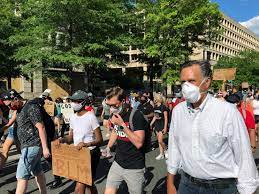
Listen/look/feel me, I have always voted based on candidates’ political positions. If a few folks supported pretty much the same stuff, I might look at other factors. If someone comes off as a condescending asshole or has a plethora of rumors swirling about personal issues, I might reconsider; but I helped run a city council campaign for a guy who treated me worse than any boss ever has in my life. Despite the humiliation, I stayed because I thought he was the best candidate. (No, I’m not proud of that decision and do not encourage anyone to do the same.) But if I could truly look into the heartmindsoul of each candidate and vote on that, I might go the way of the spiritually-driven voter. I know people questioned the sincerity of Romney participating in a Black Lives Matter march back in 2020, but if that generated any votes, it was far less than he lost in standing up to the Republican party, so I have to trust his sincerity. And appreciate it.

Of course, of course it doesn’t have to be religion. It can be personal integrity, responsibility to one’s community; even true patriotism (a concept that scares the shit out of me) has occasionally been enough to withstand Trump’s infectious poison (e.g. General Mark Milley). But without any foundation in love or faith or ethics or responsibility (Have you no decency, Sir?), without any motivation other than holding office, holding office ceases to have meaning and those who do it simply bend with the prevailing winds. The Republican party is run by a hungry ghost protected by sentient doormats, and as long as they have power, the voices of the (yes, infinitely too conservative for me but still somewhat) decent members will be drowned out and ultimately disappear.

Annoying Little Boddhisattvas Everywhere

Annoying Little Boddhisattvas Everywhere

I was walking with B & V after the most recent of the January 6th Committee’s televised hearings, describing the witness tampering that Liz Cheney had teased at the end, when I stopped myself mid-sentence. “My god, there’s no hatred in my voice when I say that name. Do you know how long I’ve been hating the name Cheney?” Decades of (arguably justified, if unhelpful) emotional enslavement to anger and disgust and horror around the lies, war promotion and profiteering, torture, and spying that defined her father’s vice-presidency vanished from my current self as I appreciated his daughter’s impartiality, levelheadedness, search for truth, and willingness to risk her political standing for our cherished institution of democracy. She has shown me that I can let go of the fraught attachment to the feelings, and that the letting go is not a forgetting or absolution. I think her political philosophy is inhumane, plutocratic, and destructive. I think her father was a war criminal. I would doubtless vote against her if I had a chance to do so. And I can hold all those beliefs and take any oppositional actions made available to me without hating her, without feeling any tension or revulsion at all; fully recognizing her as a part of the greater human mess and a person worthy of compassion. Liz Cheney has helped lower the bar in the best way, though I’m still working to drop it further: how little can I understand or sympathize with a person’s actions or beliefs and still empathize with them as a part of me, an interdependent element of my complicated world?

In the 90s, Ram Dass’ shrine featured Neem Karoli Baba, Buddha, Jesus, and Bob Dole. (Remember when Bob Dole was the ultimate enemy? FunnyNotFunny?) He said when his gaze settled on the latter photo, he would feel his heart tighten, and know where his “spiritual homework” lay. I don’t have a shrine, but if I did today I wouldn’t put Trump on it. I’m not welcoming that daily dose of constriction, but I know it’s something to strive for.

Last week, while picking up garbage around the community center where I volunteer to hang out with unhoused and economically marginalized and other random folks from the area, a guy started harassing me about why I was cleaning up there. He wasn’t happy about it and wasn’t, I realized a few sentences in, interested in actually conversing with me so much as lecturing me, and it wasn’t pleasant. But it didn’t take long for me to recognize several truths he had unveiled. First is my persistent desire to be liked and even appreciated, which has been a barrier for as long as I can remember – causing an often immature reaction to criticism and at times preventing me from being honest with people when it’s important to do so, and, as in this case, taking too personally words aimed at the idea of a person, and having little or nothing to do with me. I also have a compulsion to explain myself, which I guess I can attribute to ego attachment. (As my best friend once said to me, “I bet you’re one of those motherfuckers who has to explain why you’re leaving to your boyfriends.” It had never occurred to me that not doing so was an option.)

When my critic was giving me shit about “my own house,” I also had to recognize that I have neglected my own community in favor of coming to this one every week. I view the unknown neighbors on my block as unworthy of my attention – comfortable, middle-class white people who are so polite and reserved that I have written them off as repressed and dull. I have thought about hosting a happy hour, but never done it. I have convinced myself that I wouldn’t know what to say to them, yet I’m literally and figuratively going out of my way to converse with what are often mentally or chemically ill folks in another neighborhood. I’ve often declared in the past several years that my particular talents serve best through my talking to well-intentioned White people who don’t see the destructiveness of their internalized racism, ableism, etc. yet I do that almost exclusively in structured, deliberate environments, rather than creating open spaces where those meaningful conversations might unobtrusively and effectively seep in. There is work to be done here.

The final and perhaps most successful boddhisattva who came into my life recently is The Fireworks Guy. I liked fireworks well enough as a kid, but both of the dogs I have lovingly raised as an adult have been terrified of fireworks. Like most good mothers, I have loyally hated the things that cause harm to my kids. A few weeks ago we took V to our local dog-friendly restaurant patio for the first time in a year, and as soon as the server delivered her beloved marrow bone, a massive firework went off a few houses away. V started shaking, I yelled an obscenity, and B took off in anger (rare for him) to find the people who did it. What he reported back was that the guys (a racially mixed group) saw the fireworks as an intentional act of rebellion to annoy “yuppies”, protest “gentrification”, and generally disrupt people’s comfort. On the flip side, I have long held fireworks to be a deliberate act of toxic masculinity, symbolic violence, and cruelty towards nearby animals and traumatized humans. In fact, there’s little truth to either my accusation or their justification, certainly in the sense of a higher truth. Both beliefs are lacking in compassion and overflowing with resentment and blame. Something clicked in me after B’s interaction, and I made a conscious decision to stop getting angry about fireworks. V isn’t nearly as traumatized by them as she used to be – CBD chewies have worked wonders, and thunder (which we can’t pin on anyone) is much harder on her nerves – and I’m tired of crafting narratives of cruel, abusive men in my head. There are enough real ones out there. I haven’t got time for the pain.

Weirdly, that worked like an off switch. Once I let go of my manufactured justification for harboring the anger, the anger disappeared completely. I still don’t like the sound of fireworks, and I still wish it didn’t bother V, but I’m no longer wasting a single iota of energy on hating the perpetrators. Crazy, right? I’ve certainly tried to let go of emotional attachments in the past with far less success. I don’t know if this one came easily because I’ve been practicing more, or because I recognized the weirdly ideological motivation for the resentment or what, but it does give me hope for my indubitably lifelong efforts to let. shit. go.

Thank you to all my teachers.