Old Dogs and Dying

Old Dogs and Dying

In Spanish and other languages the parts of the body aren’t possessive. It’s la mano, la cabeza – not my hand, my head. In the meditation practices I follow, we are asked to do the same with thoughts: noting “thinking;” not “I’m thinking”. Most helpful for me: labeling sensations in a disinterested manner. Not, my foot’s numb, my knee hurts, but pain is being experienced. That’s a bit long for me, so I tend to go with pain is happening, boredom is happening or numbness exists, tension exists. It’s a deliberate method not to defer the feeling, but to universalize it. When we attach to our pain, it isolates us – whether it sets us apart as uniquely victimized or uniquely ignored, it sets us apart. When we use our pain to, if subtly, acknowledge the experience of pain everywhere, at the very moment that it’s manifesting in us, it has the opposite effect of opening us up to the world and our place in and with it, and simultaneously, if subtly, transforming our interpretation of the sensation or emotion from something negative into something that simply is.

In one of the books on dying that I’ve consumed (maybe Atul Gawande’s Being Mortal), a man who had lost his oldest son to a genetic condition in his late teens was asked how he got through that tragedy, how he could stand losing a child, he simply said, “He was a wonderful person, and it was an honor to have known him.”

This response, or my memory of it, has stuck with me for years. It comes up almost every time I think about the death of someone I care about – past or eventual. There’s so much in this simple answer. I think it struck me first because it didn’t seem like a response to the question asked. (Something I tend to notice because of my ridiculously literal approach to conversation.) No judgment! I mean, look what this guy had to suffer through. But in fact, it is an answer to the question, and there’s no suffering in it. He “gets through” it because it’s a privilege, it’s a gift. While I have no doubt that this man himself felt as much pain as any of us would in losing a child, it’s not about him. It’s about them as a mutualistic partnership, of shared love.

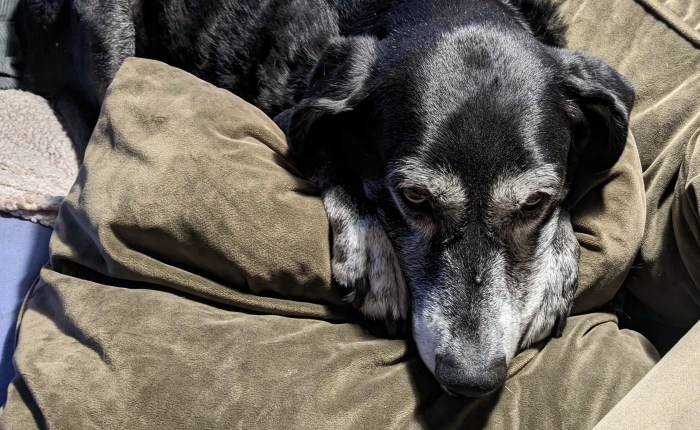
Our dog, Vicious, is old. Not crazy old, but she’s outlived the average lifespan of her major breeds, she’s quite deaf, and she has issues with her back legs (alleviated by some great drugs – science!) B & I both struggle with our fears of losing her. I see it in him and myself, whether we put it into words of not – the way we stare at her when she’s sleeping, the excessive concern when she simply trips or gets up a bit more slowly than usual, the occasional moment of panic after being particularly delighted with some weirdness of hers. When I joke that “it will kill us when she dies” I’m not joking. A part of us – individually and collectively – will die, and something else will likely replace it – the shared sadness, the shared loss, the shared history. I’ve had to talk myself down many times over the past year or so … finding myself obsessing about losing her, working myself up into a frenzy, and then confronting myself with the simplest, most obvious truth, one I’ve been studying for nearly two decades: be here now, bitches. And instead of lying in bed thinking about her being gone, I go downstairs and cuddle her on the couch – whether she likes it or not (she’s neutral). Sometimes it’s hard for us humans to truly understand why living in the future is such a waste of time; it’s so much a way of life that it doesn’t seem harmful at all. But when confronted with a future loss it becomes so fucking clear. I can experience the pain of losing her once she’s dead, or I can torture myself by experiencing the pain even longer! Right now, when I could be appreciating her! Awesome!

Of course we can’t stop ourselves from thinking about the death of loved ones, especially if they’re old or ill, but if we can redirect whenever we catch ourselves – just like coming back to the breath in meditation – life is so much better. We can’t prepare ourselves, emotionally, for tragedy. We can make practical plans, whether logistic, financial, what have you, but the pain you feel when they’re gone will not be lessened one iota by the anxiety you invested in the loss beforehand.

So that’s helped. But then there’s this additional element introduced by that incredibly equanimous parent. The thing that strikes me most about his response is his detachment – not from the experience, but from ownership. It wasn’t that is was his son, his loss: his son was a person in his own right – a wonderful person – who he was honored to know. As I’ve been mulling this over in relation to V, it’s amazing how much spaciousness it gives me. When I think of her as my dog, she begins and ends with me, with our introduction to her existence. But when I think of her as the highly specific, weird freak that she is – one born before I knew her and perhaps inhabiting some kind of consciousness before then; one who has moved countless people and been idolized by the occasional dog, one who will continue to live on in all of us, in our memories and the feelings and experiences she inspired – (in exactly the same way she lives on now when I’m not in her presence), one who makes choices and has preferences unrelated to me or what I want of her – then losing her is painful, devastating, but not catastrophic. She will have left us, but she hasn’t left. Everything dies, but nothing ever leaves. We are all literally made up of the same particles that existed at the beginning of matter as we know it. Vicious is just a sedate, introverted, tolerant, yardwork-loving, floppy eared version of a particular collection of elements and, if you believe as I do, a particular manifestation of consciousness. This understanding won’t make me any less sad when she dies, but when I think about her inevitable departure from that perspective, I feel less suffering, less individual attachment to her and more, like that enlightened father, a feeling of unbelievable luck. I got to care for this exceptional creature. I got to spoon her in the morning; I got to stare into her beautiful brown eyes and wonder what she thinks when she looks into mine; I got to watch her prance like a horse and chase turkeys and lie in the sun with her eyes closed and her head in the air. Particularly knowing when I took her in that she would, barring some anomaly, die before me, how can I regret her loss? If I see her as a visitor, as a gift, it’s all good. Everything is impermanent. Everyone leaves us, or we leave them. It’s all just a matter of how much presence and gratitude I can bring to her right here, right now (when she’ll let me).

If we can do this with our loved ones, it may be a better way of honoring their existence, their journey on this planet, and help us let go a little more easily when they leave.

(I write this now, of course, because I won’t be able to write it when she’s actually gone, but I may be able to read it).
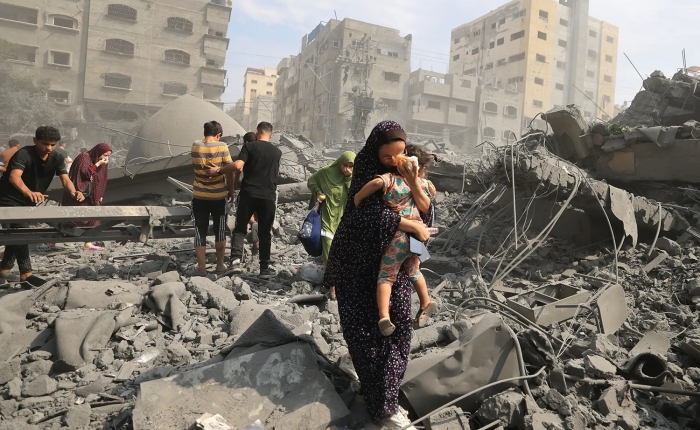
Israel/Palestine Feel It? Or Fight Over It?

Israel/Palestine Feel It? Or Fight Over It?

Once again … still … always … these are difficult times, friends.

To be honest, I haven’t been digging into world news much. I get the lowlights from NPR and Seth Meyers, and haven’t sought out a whole lot more. I’ve downloaded podcasts about what’s going on in Israel & Palestine and the specific cognitive dissonance of liberal American Jews, but I haven’t listened to most of them. When I have a few minutes free, chomping down PB&J before moving onto other responsibilities, I’ve generally sought out educational pieces on the history of Israel & Palestine, not reporting from the front lines. This practice hasn’t felt right, but it also doesn’t make my heart hurt. And I’ve got other stuff on my plate.

My beloved online sangha had our monthly checkin on Halloween and I was late due to candy responsibilities and missed what was going on with the Jewish women in the group. I assumed we were all on the same page politically – this is a spiritual community that came out of a Socially Engaged Buddhist program, so we tend to agree on issues – but it became kinda clear I wasn’t really with them in spirit. On my turn, I talked about my disgust with what’s happening and what’s happened, some difficult conversations I’ve had with an anti-Muslim guy at The Listening Place, sympathizing with anti-Israel protestors while questioning the tone and content of those protests, and basically just spitting out whatever random shit was floating around in my mind. Someone else spoke, we sat in silence for a bit, and then one of my Jewish Sisters said,

We’ve been kicked out of everywhere. Where is there left for us to go?

And I finally felt it. I felt there was something deeply lacking in my engagement. I felt that I was behaving in a way that was human-adjacent, instead of truly sinking into the human horror of the situation. And it wasn’t just that I haven’t seen many images of what did happen and what is happening (though that is true), and it’s not that I don’t have sympathy (I do), and it’s not that the fog cleared and I saw the clear path to the right way to witness this conflict, but I knew what I was doing was wrong.

It wasn’t until a dear friend and I connected today that I figured out what was wrong, or rather we figured it out together. She and I are both Jewish, but almost entirely by heritage. Neither of us grew up in a Jewish culture or in families that practiced Judaism, culturally or religiously. We did both grow up in highly political families – left-wing, activist, anti-war families. That was essentially our religion. So in the same way that Jews, no matter how liberal, may have a bias when it comes to Israeli sovereignty, we have a political bias that colors our perception of what’s happening. And that obfuscates the humanity of the situation just enough to where I am not witnessing in the way that a Socially Engaged Buddhist should.

What does that mean?

Well, it’s subtle, and it might be almost imperceptible from the outside, but putting the political ahead of the human suffering changes the way I think and talk about what is happening. It turns on my brain and dampens the embers of my heart. And that is not how I want to approach suffering. I want my eyes open, my heart aflame, and my brain subservient to the two (three) of them.

Example: the conversation with the anti-Muslim guy referenced above. He has a sweet disposition and a lot of knowledge, but in his homeland, Bangladesh, his mother was slaughtered (his word) by Muslims, and he has a deep and understandable bias against the religion and those who practice it. During the usual invitation for prayer requests, he asked that we think of the hostages and all the Israeli people who had suffered because of Hamas. I countered with, “and all the innocent Palestinians who are being bombed and killed by Israel.” I knew about his Islamophobia, and didn’t want it to go unchecked. Since he is really a kind and engaged person, we had a pretty long talk about it afterwards. He knows more history of the area than I (questionable though it may be) and knows more of the Koran than I (again, from a particular perspective), and while I knew everything he was saying was not true, I was unqualified to meet him where he was at. Eventually I said that I really didn’t think we could continue the conversation because we couldn’t agree on basic facts, and that he wasn’t going to convince me (as it appeared his intention was) that Islam was a fundamentally and distinctly violent religion. This was all done in a calm and friendly manner and we had a pleasant interaction on a different topic a short time later. It isn’t my tone that I’m trying to fix here; it’s the foundation of the discussion. It was futile to even engage in a conversation based on history and religious beliefs, and not just because of my own ignorance. It’s because all of that background is intellectual, and our brains will defend that apparent rationality to the death. The only way to chisel a crack into that hardened foundation is through the heart. It’s the heart that led him down that ideological path – his broken heart for his murdered mother – and it’s only the heart that has a chance of changing him again. Instead of arguing about the righteousness of one side of the other, we could have addressed the suffering of the families. We could have talked about the children. We could have simply acknowledged the pain of the human beings caught in this hell. We could have softened our hearts instead of entrenching our positions. We could have empathized instead of trying to win.

Would it have done any good? I don’t know. But I am more interested in the long game than the winning this particular pot. If there is anything I can do to help this man let go of some of the suffering that he interprets as hate and disguises as justification, it won’t come from arguing the merits of the Palestinian position. It will only come from love. I’ve spent a lot of time studying how to talk to people about race in the last decade, but I still fuck up fraught conversations constantly. Of course, I feel far more comfortable arguing over the history of Black people in America than I do the Middle East, but my comfort or familiarity is not the point. It always comes down to coaxing our humanity to the surface. Not just the humanity of the people we’re demonizing, but the humanity of the person who’s demonizing them. I should have asked him more questions, confirmed that I was understanding him correctly, and kept coming back to the people and the suffering. No, we wouldn’t have resolved out positions or, certainly, the war itself, but a seed might have been planted for a bit more growth in the future, a little less preaching and a little more witnessing, a little thimble of space for holding these victims with care and respect before jumping back into justifications and self-righteousness.

I don’t know. But I do feel, feel, that the way I’ve been approaching this isn’t right. Buddhism is pretty deontologist – since we can’t know how things will turn out, our attention is focused on performing as wisely and lovingly as we can in the moment. There are no ends that will justify an immoral means. So killing civilians in order to stop a terrorist is hard to justify. And cultivating compassion is always a good choice, even if it does nothing to end the war of the moment.

Ideally, compassion would bring us to a place of peace. But I’m not naïve enough to expect that in Gaza. I can only try to practice on a small scale what I want from the world at large, and my heart won’t let me do otherwise for long. Witnessing the pain on both sides hurts, but protecting myself with an intellectual glaze just feels gross, and I hope I’m past that for now.

Finding Refuge

Finding Refuge

If you’ve studied any Buddhism, you may be familiar with the concept of Taking Refuge. If not, don’t fret! This is not a post about formal Refuge or any formal Buddhist practice. Refuges are everywhere, and it is our skillful or unskillful use of those that intrigues me most.

Buddhists take refuge in the Three Jewels: the Buddha, the dharma, and the sangha. This is done as a formal ceremony, but can also be performed as a private practice or affirmation. If you know my blog, you know I gravitate towards the informal route.

I’ve mulled over the three treasures on occasion. It’s not much of a stretch for me to get there, depending on whose interpretation I adhere to. The hardest for me to get behind, ironically, I guess, as a Buddhish type, is the first. What does it mean to take refuge in the Buddha? For me, it is either the idea that a being without illusion and attachment could exist, which is heartening; or the idea that Buddha nature is in all of us, which is even better. The dharma, the teachings, are obviously instrumental in guiding my life and decisions; and the sangha, which for me is my community of like-minded practitioners, be it the Western Buddhist leaders whose writings I rely on, my online sangha left over from the UPAYA Socially Engaged Buddhist group, or just the world of fellow meditators who are trying to live a life free of inflicting or indulging in suffering.

Nonetheless, when the Refuge-focused, 3 week intensive with my local meditation center started, I didn’t really have any idea of what Refuge meant outside of these strictures and the dictionary definition of the word. When we were encouraged to consider where we find refuge and where we don’t, I really didn’t know where to begin. A lovely Buddhist teacher couple whose daylong retreat I attended in November came to mind — they had asked us to find a place in our experience or memory that we could turn to when times were difficult. I have good, safe memories, but none that stood out as worthy of developing or grasping, and isn’t the point to be good with where we’re at?

So now I was being asked to look at my places of refuge again. Have I completely misunderstood Buddhism? or are we, mere mortals, being invited to indulge in stopgap measures while we float in the moat outside of enlightenment?

I eventually listened to the talks we were assigned (usually a good idea) and realized I was more aligned than I had thought. The idea was not to find more places to take refuge, but to recognize the ways in which we try to find safety in helpful, impermanent, silly, or even destructive things. I have plenty. Here are some choice ones:

  • food – a constant battle: eating out of boredom, depression
  • filler noise – podcasts while I do repetitive, mindless work
    • What’s the harm there, you might say? Well, one, that I stay in a job in which I am regularly bored; and, two, there is ample evidence that when humans try to distract themselves from unpleasant tasks, they always feel worse, not better: the task is more demoralizing the less you engage with it. This also gels with Buddhist beliefs
  • drama – there’s been plenty of that at work lately, and I can feel myself being energized, maybe made frantic, by it. The drama is destructive. It is causing real practical and emotional harm to many people, and I don’t like that, but I do like how it makes me feel. I am not bipolar, but I have so much sympathy for folks who don’t want to give up the mania in order to mitigate the depression. It’s enlivening.
    • I used to feel this way about anger – what is more invigorating than anger? – but I couldn’t handle the hangover. I couldn’t control it, so it controlled me. It was so destructive that I couldn’t help but recognize the harm it was doing and to loathe the feeling it generates in me. But I still like drama.
  • sleep – not a bad thing, but in winter I can prioritize sleep and just lying in bed over pretty much anything, if I let myself
  • reading – again, not bad in isolation, but as a substitute for doing things that need to be done it’s still an issue
  • gossip – I don’t think of myself as a big gossip, but it’s been tied up with the drama at work. If only we got the same thrill in praising others as we do in talking shit about them…
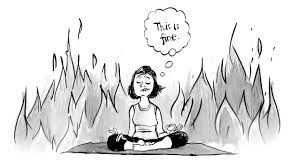
  • exercise and cleaning are both immensely beneficial to my wellbeing; I don’t know how I’d get through winter without them. I suppose they only become a false refuge if used as a substitute for facing up to truth. I believe even meditation and retreats can be false refuges if done for any reason other than awakening. There’s a New Yorker cartoon I saw long before I started meditating that still sticks with me: a man meditates, looking peaceful, while a closet bulges off the hinges behind him. I couldn’t find that one, but there’s some gooood meditation comedy out there. Here’s one (courtesy of Ginny Hogan & Jason Chatfield).

I have certainly used sitting to avoid one thing or another. One challenge for me is distinguishing a false, harmful refuge from a simple, mostly harmless, or even beneficial, distraction. If I sit now instead of doing that work thing, won’t I approach working more mindfully? Eventually? If exercise staves off depression, doesn’t that help me update my resume? Someday?

The truth is, I’ve been doing this for long enough to know when something I’m doing is avoidance disguised as meaningful action. I may not know why. I may not be able to stop it. But I can feel it when I’m efforting all around the problem and pushing life further down the road. Ugh. Consciousness is hard.

Even harder is forgiving yourself and letting your fuckups just be. The oxymoron is almost as confounding as the belief of the Socially Engaged Buddhist: nothing to do in a world that is fine just as it is, and everything to do in a world of prevalent injustice.

I haven’t committed to this intensive practice period as much as I would have liked – there are so many things going on this time of year, and so many things going on in parts of my life, that I’ve only gone a wee bit beyond upping my daily meditation time. But it still helps. It helps me deal with the demands for attention and the temptations and the cold and the sadness for the people in the cold. I’m grateful for all of it. And for all of you who let me write about it. This blog is definitely a refuge for me.

The Lesson You Need

The Lesson You Need

If you’re on “the path,” as we spiritual nerds call it, you’ve doubtless found yourself connecting more intimately with some teachings than others, and that changes over time & circumstance. I have been glued to this one for a few months now, and it’s been life-changing in that subtle, Buddhish way.

I don’t actually remember who this came from – a contemporary Buddhist text or dharma talk, or Ram Dass or one of his ilk, or all of them. But it fits into all of that stuff. There are lots of ways to phrase it, but I like this:

The lesson you need is always right in front of you.

There are lots of ways to interpret this. You can go with the idea that everything is preordained or meant to be. Despite not believing in free will, I don’t find that helpful. For me, it’s another version of the belief that every moment is an opportunity to awaken. But it’s better. Because awakening seems beyond my control. I can’t reason myself into awakening, so perpetual opportunities just seem like missed opportunities. But the lesson I need being here, right now? And not having to sign up for another intensive retreat to experience real spiritual growth? That I can work with.

Basically, it turns every difficult or shitty thing into an opportunity for practice. How can I Buddha my way through this situation? Now that moments present themselves in this way to me, challenges have become a fun and enlightening game.

My partner’s changed our plans at the last minute? Okay. Am I attached to the previous plan & if so, why? Would getting pissed off at this moment improve anything? Teach anything? Cause suffering? What does my past experience tell me?

Someone wants to discuss a topic on which we are ideologically opposed. How can I open my mind while still being genuine? How can I be simultaneously engaged in the conflict and loving? Can I hear what they are saying without shoving them into a pre-labelled box? What is my goal here and what is theirs? Is mine driven by ego or empathy? Can I find a way to connect & namaste either within or outside the strictures of that conversation?

At the State Fair: why do I feel the need to judge my fellow fairgoers? What is it in me that is reacting to something utterly superficial in them, whether it’s how they look, the clothes they wear, or the slogans they brandish? How can I soften that?

Even moments far pettier: I think we’re supposed to cook something one way. The guy thinks otherwise. Instead of fighting him on it or grasping onto my opinion at all, I admit that I just heard my theory somewhere and have no idea whether it has any validity. We carry on from there.

Put another way, in one of Ram Dass’ lectures he recalls requesting a particular type of microphone for a talk he was giving, and when he arrived they didn’t have it. He started to get pissed off, then recognized, “oh, there’s my yogi, disguised as a microphone.”

Some of you will likely think this isn’t even worth sharing; others may find it revolutionary. I haven’t even told you the best part yet: I do this all without self-criticism. When everything is a lesson, I’m showing up as a student, not a fuckup or an asshole.

I can’t adequately express how much lighter the combination of pausing, sitting in not knowing, and the lesson perspective has made everyday challenges. So much of it is about space, which feels to me like a pause paired with a distancing and a refreshing breath. That Space allows the witness room to step in and observe what’s actually happening outside of the ego; outside of an agenda, personal history, or judgement. The witness doesn’t tell me what to do, it just gives me perspective. All I do with the perspective is bring it into my thoughts and actions and see where it takes me. It infuses a bit of wisdom into the situation, which allows me to make better, more conscious, more loving choices. I cannot recommend it enough.

Blooming Through the Unbearable

No danger that we are facing today is greater than the deadening of our response.

Roshi Joan Halifax, 7/18/2022

These were some of the first words shared at a talk centered on the spiritual Deep Ecology work of Joanna Macy Sunday, and a beautifully expressed warning against meeting immense challenges with despair.

That includes global warming, which refuses to fade gently into the night. And it’s a doozy – the most overwhelming, global, human threat to date, or at least for tens of thousands of years. A friend saw Elizabeth Kolbert speak at a university a few years back and was appalled when she answered the inevitable audience question of “what can we do?” with something like, Nothing. There is nothing you can personally do that will stop the headlong tumble towards an unlivable human planet. Here is where she is literally right: our household recycling, our composting, even our electric cars and solar panels are not enough, individually, to make a difference. The only individual actions that could make a dent would be those of leading political figures or the CEOs of prominent polluting corporations.

Here is where she is wrong: there is no such thing as an individual, isolated action in a living, social species. Not only do we bike instead of driving, we normalize biking and spark interest in others. We get the attention of those who want to sell bikes, who create tempting advertising around biking, generating more participation. Politicians glom on to boost their cred with the voting bloc of cyclists. Communities organize and successfully advocate for safer and more accessible bike paths, and more fearful folks now join in the ~carbon-free fun. The press reports on the changes in city planning. Car companies produce more electric vehicles in attempt to lure climate-conscious riders back. No single action occurs in a vacuum, and all have unseen reverberations.

And here is where she is deadeningly wrong: we have no idea what will actually improve our chances on planet Earth. That Not Knowing isn’t just a Buddhist practice, it is as scientific as it gets. Every scientific “truth” is literally a Theory, even the ones we take as gospel. No one knows how high the temperature will get, what exactly that will mean for our viability, or what might deflect us from that path. We have good models and predictions and explanation that we use to guide our actions, but we do not know what awaits us. Some people find this frightening. Some cling to the best guesses and worst case scenarios and despair in the presumed inevitability of The End. But Not Knowing, as a practice, is ultimately liberating. If we don’t know the future, we are free to accurately assess and focus on the present: is this act loving, kind, compassionate, meaningful, wise? Is it done for its own sake and not to reward my ego? Am I using the terror of the future to justify cruel behavior in the present? Whether it all fell apart tomorrow, or humanity were saved with the sunrise, would this still be a Right Action?

And here’s the other spiritual bit, the bit that Roshi Joan alluded to at the top: If we close ourselves off to action, because we believe it won’t fix anything; to our own heartbreak, because it hurts; to the pain of others, because it’s hard and uncomfortable; to lapping up the beauty of our world, because it will go away; to laughter, because there are so many reasons to cry; to love, because of impermanence, why are we even here? We do the best we can because it’s the right thing to do, not for an anticipated payout. Better to fail to save humanity by using less and loving more than to succeed by brutally annihilating a third of the population, right? It’s not about the fix; it’s about nurture.

Impermanence is the (admittedly shaky) foundation on which the Four Noble Truths sit. Everything is impermanent, including us and our planet. From the Buddhist perspective, it shouldn’t matter whether Earth’s temperature rises by 4 degrees Celsius tomorrow or in 2500. The urgency may increase, but the mindful behavior would be more or less the same.

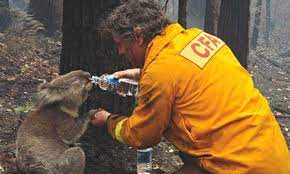
Or maybe I’m wrong. Certainly the ongoing Heat Death of living creatures and landscapes makes me ponder quitting my job and devoting myself to whatever beneficial behavior I can muster up, and the likelihood of that happening increases as record-breaking temperatures and other environmental events become more dire. But I (breathe) try to return to the center of kindness, empathy, joy, and love. I love being alive. I love this planet so much it hurts. And I’m working on loving the people who share it with me. If I let my fear control the narrative, that love turns to despair. And there is really no reason to despair, because we are here in this unbearably beautiful place, and every moment is an opportunity to help others see it. Sitting with one suffering person is lifechanging. Planting one hazelnut tree is lifechanging. Feeding water to one parched koala is lifechanging. Returning one starfish to the ocean is lifechanging. No single one of us can stop global warming, but the lives we live can contribute to a wave of carbon reduction, and every single one of us can contribute to the wellbeing of a living creature on this gorgeous Earth.

What We Sacrifice: Wynn Bruce

What We Sacrifice: Wynn Bruce

I have been trying to spread the word about Wynn Bruce, and whenever I do I get choked up and blurry eyed. So it seems I should write about him. Wynn Bruce set himself on fire in front of the Supreme Court and died a few days later, a few days ago.

Wynn Bruce was a Buddhist and he cared about the warming planet and he set himself on fire. He was not explicit about why, or only in a coded way, but his father and his friends believe he was intending to call attention to climate change. He would not be the first to do so. I fear he may not be the last.

It’s hard to know how to feel about this. That is, it’s hard to have one feeling about it. It’s horrifying, brave, ridiculous, extreme, understandable, admirable, and frightening. As a pseudo-Buddhist, I rest primarily on honorable and heartbreaking.

Bystanders said he didn’t scream as his skin burned.

I can’t say this is the wrong thing to do, if he wanted to do it. It appears that no one ever suggested it, so there is no fault to be laid. I can’t say it’s the right thing to do – causing pain to loved ones in a deadly act that will have little, or any, impact. Removing yourself from the playing field, instead of staying in the loving fight. I wouldn’t argue with a chronically, fatally depressed person who took their own life.

Is it even suicide?

The only thing I can say, the only thing I may know, is that if he burned himself alive in order to call attention to Climate Change, we owe him the honor of paying attention to Climate Change. I don’t know what paying attention means to each one of you; I just believe that we bear witness to his death by bearing witness to the deadly changes in our living environment.

He attributed this beloved quote to Thay:

The most important thing, in response to climate change, is to be willing to hear the sound of the earth’s tears through our own bodies.

thich nhat hanh?

There is more than one way to do that. It will be painful, but it may also be generative and invigorating. The end is uncertain, but despair is not an extreme reaction. I hope we can move past it.

Creative Imperfection (Perfection, pt 5)

Paris through the Window, Marc Chagall

We would have stagnated and likely died off as a species if we had settled for perfection. Evolution requires variation – a mutation from expectations, from what was extant or even conceivable before it happened. Our selectively cultivated foods – our pluots and actually tasty apples – came out of a desire for variety and difference: improvement, not perfection. When the focus shifted to profit, perfection took primacy over variety. (In the narrowest sense of the word profit, meaning a strictly financial benefit for the titular “owners” of the item in question, because the loss to the world has been enormous.) When we move from variation to perfection, we get shit. Look at the strawberry. Mass produced, global strawberries are engineered to be very red, very large, and very firm – the perfect image of a strawberry, and perfect for easy picking and long, bumpy transport. They are also flavorless. We are so averse to imperfect looking foods that we created a space for an alternative, radical industry based on selling “ugly” produce to people on subscription, because grocery stores won’t sell them. Because we won’t buy them. Perfect-ly good food, wasted because it doesn’t fit our model of what a particular food should look like.

Likewise, any ideal is just as timebound, subjective, and limited. Who created these standards? In the US, certainly, they are largely male, wealthy, White, able-bodied … you can keep adding privileged identities. What are those guys missing? The answers are infinite. Their idea of perfection has led us to waste food, people, ideas, art. Perfect children were quiet and still and obedient. Perfect citizens conformed with social expectations and followed laws, which have at many times been exceptionally cruel and immoral.

What even is imperfection? Is it just a name we give something that doesn’t fit the way we want it to be, the way our necessarily limited human expectations circumscribe the parameters or potential of a being or object? Is perfection simply acceptance? Is that what Neem Karoli Baba demonstrated when he instructed Larry Brilliant to eradicate smallpox while unironically insisting that everything was exactly as it should be? Is a world without pain and horrors a perfect world? Or is the world always perfect, regardless of Global Weirding, genocide, pick your cause; and is our empathy and grief and work to change those circumstances as inextricable a part of the perfection as the ghastly circumstances themselves? Is a perfect world one in which suffering is present for us to relieve? Is that super self-serving and monstrous? That, just as plants and animals must die to feed other plants and animals, and forests must burn to allow for new growth, our human world must be filled with resource extraction and cruelty? Maybe. Or maybe we just throw out the idea of a perfect world and instead live the paradox of simultaneous acceptance and opposition.  

Buddhist, Native American, and other religions imply the idea of an individual entity being perfect independent of the community which literally and figuratively keeps them alive is absurd. Our selves don’t end at our “skin-encapsulated ego” (Alan Watts), and neither does the strawberry’s. That perfect strawberry is here reinterpreted as a massive failure because it poisons the soil, the farm workers who pick it, the air we breathe through the chemical inputs to grow it and fossil fuels to ship it; and denies nutrients and spreads disappointment to the people who eat it. In these interconnected worldviews there is no place for perfection, which attempts to delineate something that is by nature fluid. As the infinitely amazing Deep Ecologist Joanna Macy writes, we have deluded ourselves with the idea that power, or success, means domination. “This is not the way nature works. Living systems evolve in complexity, flexibility, and intelligence through interaction with each other.”[i] Evolution is never just personal; our environment decides which mutations are worth reproducing. Every creative act, every change is a collaboration between living things and their environments and cultures.

In the creative realm, the concept of perfection puts restrictions on what a thing can be, and creative potential can be smothered by such boundaries. If there is perfection to be reached, there is an idea of what is acceptable or appropriate, and therefore an unspoken idea of what is unacceptable, which is pretty much anything unfamiliar and innovative. If War and Peace is “the perfect novel,” where does that put The Vegetarian?[ii] Or Beloved? Or any number of works from other cultures that I have not been exposed to? What is a perfect face and who decides that? We’ve all seen the destructive potential of “the perfect body” and many carry that burden to the detriment of our health and happiness. The idea of perfection has led us to waste food, people, ideas, art. At one time, perfect art was representative, and representative only of the “noble”. Every genre of art rejected the previous genre’s idea of perfection. Nadia Comanechi achieved “perfect 10s” in her Olympic routines in the 70s. Now that same performance wouldn’t even get her into the Olympics. But that’s just time, you might say. Indeed, time is a characteristic of culture, and just as arbitrary and whimsical in classifying excellence. Think of all we would want (in the dual, Shakespearean sense of the word) if previous standards of perfection were enforced. Future creators will say the same thing about our standards, even though that is hard to imagine. A culture of perfection makes the new harder to imagine. We assume that we know what a thing can be, and knowing is the beginning of the end. A beginner’s mind is a space for exploration, creativity, and growth; an expert’s tends to resist change

With perfection out of the way, there are so many more ways to be. Perfection is static, proscriptive, and therefore inhibiting. If the nature of all being is boundless, as Buddhism and psychedelics tell us, then either nothing is perfect, or everything is. And if we are perfect and thereby liberated from the pointless goal of achieving perfection, what could we do with the energy we now spend on self-improvement and material comforts to salve our cravings? We could make gloriously imperfect art, perhaps, or grow imperfect tomatoes, or form imperfect, diverse, messy, mutualistic communities that cultivate the joy of future imperfections.


[i] World as Lover, World as Self– 30th anniversary edition, p.152

[ii] The Vegetarian, Nan Kang, translated by Deborah Smith. Perhaps my favorite novel of the last decade. (©2007, English translation ©2016)

More Moments in White Awareness

I’m attending a once-a-month, 6 month Unpacking Whiteness discussion series at a local Buddhist centerI signed up hoping to uncover an unbreakable bond between Buddhist philosophy and racial justice, where I often find conflict, at least on the surface.

More on that at some point. For the moment, I’ll just say that it has not served that purpose, at least not yet. And Yet, it has been enlightening in a different way. I wasn’t thrilled with the first session, but introductory meetings tend to be pretty thin. Most of the people in my little group hadn’t spent much time thinking, and less time speaking, about their own Whiteness and Whiteness in the world, and I facilitate those discussions whenever I can, so I was metaphorically twiddling my thumbs for much of the March meeting.

But this week things got good. By which I mean, they got vulnerable.

We started by going around the room and each sharing an act of historical racism committed by White people, preferably in Minnesota. I liked that everyone was instructed to phrase it as White actions, rather than Black or Brown or Red victimization. As in, “a mob of White people lynched three young Black men in Duluth in 1920” (fact) rather than, “three black men were lynched in Minnesota in 1920.” The passive voice is a powerful way to excise blame. I was intrigued by how many of the responses focused on atrocities committed against Native Americans. I don’t think that would have been the case in my hometown of Chicago. For better or worse, Minnesotans have more awareness of what they have done to Indians than what they have done to Black people. Many people think Black people just chose not to live here because it’s so cold or White; whereas, even if they can’t tell the story, they know Whites screwed over the people who lived on this land before us.

There were then two questions assigned to our small groups. How have you benefitted from White privilege and how have you been harmed by White privilege? The answers to the latter were particularly interesting. I honestly had no idea how I was going to respond, allowing me to, for once, answer pretty spontaneously. Everything I said bounced off of some excellent point a previous participant had made. Whether it was the shame I carry for being White; the feeling that any Black person would be crazy to trust me or any White person with real friendship; the fear of asking POC real questions about race because I know they’ve been burdened with the reality their whole lives; the oppressive White supremacist system of Capitalism and how it engenders competition, and constant dissatisfaction, and environmental destruction, and exclusion. (I highly recommend you have this conversation with a group of friends or open-minded strangers. Or in the comments below. I’d love to hear what you come up with.)

Our final task was to go around our breakout circles and say a few words about how we were feeling. One of the Zen priests, who happens to be in my group, said he felt terribly sad about the feelings of separation from POC that everyone had touched on. But I had to honestly say that I was both relieved and excited. Relieved that I had brought more muck to the surface, and excited at the prospect of embarking on disinfection. I don’t know how yet, but you can’t change what you can’t see.

Loving Autumn is a Buddhist Act

mono-no-aware“I’m loving autumn this year.”

“I thought you didn’t like autumn.”

“Yeah, that’s what I’m saying. I’M GETTING BETTER.”

Global warming helps. We haven’t had a really bad winter since 2013-14, in which a handful of terrifying commutes left me in tears more than once. Cold-induced death doesn’t feel as imminent now as it was then, but it was never logical anyway. The odds of me dying in an icy car crash in the winter are no greater than the odds of me dying of heatstroke in the summer. (I’m not going to reference that; just go with me.)

Driving was only one road of terror. I think there were some times as a kid when I was not allowed to dress as warmly as I wanted to, and I know there were times when I was outside and cold against my will, so there’s some lingering emotional memory there. And then there was the winter of 2009-10 when I worked as a door-to-door canvasser. I had regular afternoon panic attacks as I tried to will myself out the door to face another night of begging in the freezing cold. It wasn’t just the temperature (walking around in winter at night isn’t so bad if you’re dressed right – and we fuckin knew how to dress right), but being repeatedly rebuked by strangers as I interrupted their evenings to resiliently pitch environmental causes and ask for money iced over my core, and the windchill dropped with the added pressure of having to hit a financial quota every week or lose my job, leaving me so bone-cold that I couldn’t get warm enough to sleep at night, no matter how thick the down comforter.

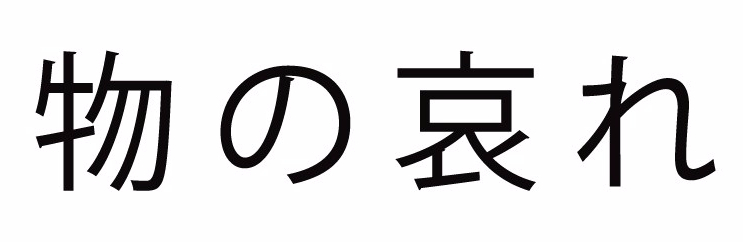
I’ve never loved fall because I fear winter. And I fear winter, clearly, not for the cold. What I really fear is being out of control in the cold, as if I weren’t out of control year-round. And when you carry that fear, fall is just an opening act for winter. Literally the calm before the storm. But fucking A, autumn is gorgeous. Such beauty in the transition of death and dormancy. I learned the concept of Mono No Aware while doing a play about Japanese art. That’s what those characters in the headline image above stand for. (Supposedly. I don’t read Japanese. The internet could trick me into promoting elephant tusks as an anti-depressant for all I know.) You can look it up yourself for an accurate definition, but to my understanding it is the ambivalent appreciation of the inevitability of transience, the wistful recognition of the passing of everything, the idea that all things are more valuable because they do not last, which is artistically expressed in the trope that things are most beautiful as they are dying. Nothing exemplifies that more perfectly than autumn.

I’ll throw in Jason Isbell here, too. I don’t know what it is about that guy, but I have fallen in love with no less with three of his songs on first listen, which almost never happens to me. I don’t know if I’ll love those songs forever, but that kind of brings me back to the point. In his most recent single (on The Current anyway), which had me tearing up on the way to work, he sings that “it’s not” (referent poetically absent) all the amazing things about “you,” but the inevitable end of their time together that makes it special:

If we were vampires and death was a joke
We’d go out on the sidewalk and smoke
Laugh at all the lovers and their plans
I wouldn’t feel the need to hold your hand

When I’ve locked in on the coming cold and dark, I’ve missed the inconceivable colors, the smells, the softening air on my ever decreasing spans of exposed skin, holding hands without gloves or discomfort. I’ll dig out my thigh-high socks, add another cowl to the collection, and gather new soup recipes for the long months ahead, but I’m lucky enough to be here now this season. I can’t promise another day of black ice won’t pull me back, but it’s really, really nice to love fall.

Buddhish Moments in Pop Culture, #1

perksI found The Perks of Being a Wallflower crammed into my friend’s bookshelf as I was waiting for the group to gather for hardcore boardgame play. I loved the movie, and it turns out I went to school with the writer (and director), and he’s apparently a good guy, so I borrowed the book and gobbled it down in less than 24 hours.

I don’t let myself indulge in fiction often anymore. And while I know that’s ridiculous, it still helps me to get off my own back if I can make a mini-blog out of it.

Or one moment of it, anyway.

Charlie is our limited narrator – a quiet, observant high school freshman who carries a semi-dormant, unspecified mental illness and few meaningful friendships until he meets Patrick and Emma – lively step-siblings in their final year of high school who take him under their wing. That’s all the background you need for the moment. You don’t really even need that, but why would you want to read about a moment in the life of an anonymous character?

… we all got quiet
Sam tapped her hand on the steering wheel. Patrick held his hand outside the car and made air waves. And I just sat between them. After the song finished, I said something.
“I feel infinite.”
And Sam and Patrick just looked at me like I said the greatest thing they ever heard. Because the song was so great and because we all really paid attention to it. Five minutes of a lifetime were truly spent, and we felt young in a good way.

I should just let that stand as is, but as J.D. Salinger once wrote, “Zoe’s voice conspires to desecrate everything on earth.” (shout out to my JD homies, whutwhut!)

I read a Paul Tillich book in a Christian Doctrine class in grad school, and it’s my earliest memory of thinking of the idea of “God” as synonymous with the infinite, as an existence distinct from the mortality of everything we can experience with our senses. This brought that back again, but couched in a simple, everyday example of how a moment “truly spent” is divine in every sense of the word. Because if the only reality that actually exists is the present moment – if the future and the past are illusory – then fully living that moment makes us immortal in that moment, which is literally everything.

Lovely, isn’t it?