Old Dogs and Dying

Old Dogs and Dying

In Spanish and other languages the parts of the body aren’t possessive. It’s la mano, la cabeza – not my hand, my head. In the meditation practices I follow, we are asked to do the same with thoughts: noting “thinking;” not “I’m thinking”. Most helpful for me: labeling sensations in a disinterested manner. Not, my foot’s numb, my knee hurts, but pain is being experienced. That’s a bit long for me, so I tend to go with pain is happening, boredom is happening or numbness exists, tension exists. It’s a deliberate method not to defer the feeling, but to universalize it. When we attach to our pain, it isolates us – whether it sets us apart as uniquely victimized or uniquely ignored, it sets us apart. When we use our pain to, if subtly, acknowledge the experience of pain everywhere, at the very moment that it’s manifesting in us, it has the opposite effect of opening us up to the world and our place in and with it, and simultaneously, if subtly, transforming our interpretation of the sensation or emotion from something negative into something that simply is.

In one of the books on dying that I’ve consumed (maybe Atul Gawande’s Being Mortal), a man who had lost his oldest son to a genetic condition in his late teens was asked how he got through that tragedy, how he could stand losing a child, he simply said, “He was a wonderful person, and it was an honor to have known him.”

This response, or my memory of it, has stuck with me for years. It comes up almost every time I think about the death of someone I care about – past or eventual. There’s so much in this simple answer. I think it struck me first because it didn’t seem like a response to the question asked. (Something I tend to notice because of my ridiculously literal approach to conversation.) No judgment! I mean, look what this guy had to suffer through. But in fact, it is an answer to the question, and there’s no suffering in it. He “gets through” it because it’s a privilege, it’s a gift. While I have no doubt that this man himself felt as much pain as any of us would in losing a child, it’s not about him. It’s about them as a mutualistic partnership, of shared love.

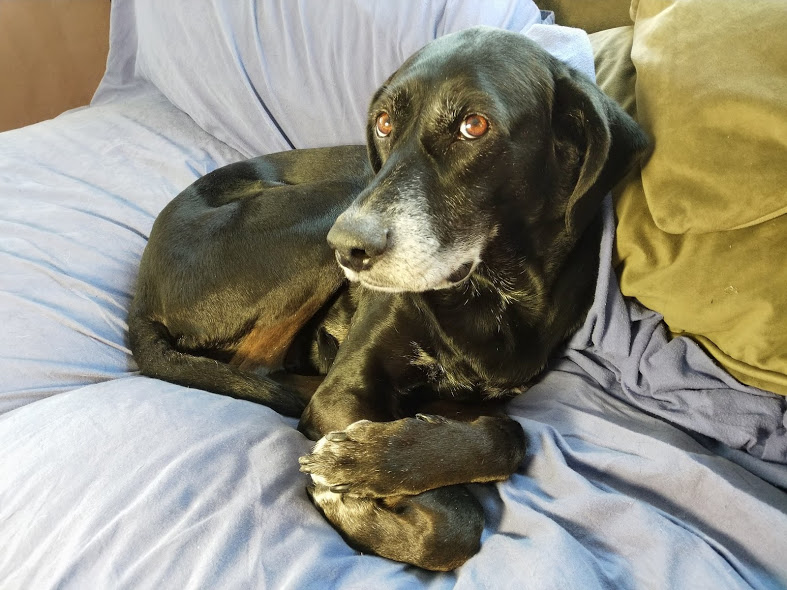
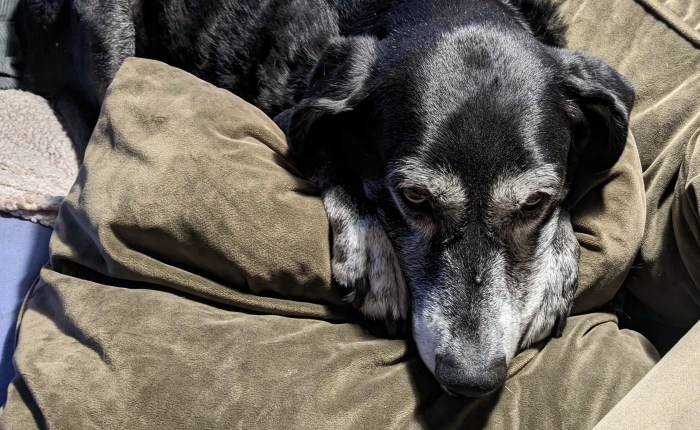
Our dog, Vicious, is old. Not crazy old, but she’s outlived the average lifespan of her major breeds, she’s quite deaf, and she has issues with her back legs (alleviated by some great drugs – science!) B & I both struggle with our fears of losing her. I see it in him and myself, whether we put it into words of not – the way we stare at her when she’s sleeping, the excessive concern when she simply trips or gets up a bit more slowly than usual, the occasional moment of panic after being particularly delighted with some weirdness of hers. When I joke that “it will kill us when she dies” I’m not joking. A part of us – individually and collectively – will die, and something else will likely replace it – the shared sadness, the shared loss, the shared history. I’ve had to talk myself down many times over the past year or so … finding myself obsessing about losing her, working myself up into a frenzy, and then confronting myself with the simplest, most obvious truth, one I’ve been studying for nearly two decades: be here now, bitches. And instead of lying in bed thinking about her being gone, I go downstairs and cuddle her on the couch – whether she likes it or not (she’s neutral). Sometimes it’s hard for us humans to truly understand why living in the future is such a waste of time; it’s so much a way of life that it doesn’t seem harmful at all. But when confronted with a future loss it becomes so fucking clear. I can experience the pain of losing her once she’s dead, or I can torture myself by experiencing the pain even longer! Right now, when I could be appreciating her! Awesome!

Of course we can’t stop ourselves from thinking about the death of loved ones, especially if they’re old or ill, but if we can redirect whenever we catch ourselves – just like coming back to the breath in meditation – life is so much better. We can’t prepare ourselves, emotionally, for tragedy. We can make practical plans, whether logistic, financial, what have you, but the pain you feel when they’re gone will not be lessened one iota by the anxiety you invested in the loss beforehand.

So that’s helped. But then there’s this additional element introduced by that incredibly equanimous parent. The thing that strikes me most about his response is his detachment – not from the experience, but from ownership. It wasn’t that is was his son, his loss: his son was a person in his own right – a wonderful person – who he was honored to know. As I’ve been mulling this over in relation to V, it’s amazing how much spaciousness it gives me. When I think of her as my dog, she begins and ends with me, with our introduction to her existence. But when I think of her as the highly specific, weird freak that she is – one born before I knew her and perhaps inhabiting some kind of consciousness before then; one who has moved countless people and been idolized by the occasional dog, one who will continue to live on in all of us, in our memories and the feelings and experiences she inspired – (in exactly the same way she lives on now when I’m not in her presence), one who makes choices and has preferences unrelated to me or what I want of her – then losing her is painful, devastating, but not catastrophic. She will have left us, but she hasn’t left. Everything dies, but nothing ever leaves. We are all literally made up of the same particles that existed at the beginning of matter as we know it. Vicious is just a sedate, introverted, tolerant, yardwork-loving, floppy eared version of a particular collection of elements and, if you believe as I do, a particular manifestation of consciousness. This understanding won’t make me any less sad when she dies, but when I think about her inevitable departure from that perspective, I feel less suffering, less individual attachment to her and more, like that enlightened father, a feeling of unbelievable luck. I got to care for this exceptional creature. I got to spoon her in the morning; I got to stare into her beautiful brown eyes and wonder what she thinks when she looks into mine; I got to watch her prance like a horse and chase turkeys and lie in the sun with her eyes closed and her head in the air. Particularly knowing when I took her in that she would, barring some anomaly, die before me, how can I regret her loss? If I see her as a visitor, as a gift, it’s all good. Everything is impermanent. Everyone leaves us, or we leave them. It’s all just a matter of how much presence and gratitude I can bring to her right here, right now (when she’ll let me).

If we can do this with our loved ones, it may be a better way of honoring their existence, their journey on this planet, and help us let go a little more easily when they leave.

(I write this now, of course, because I won’t be able to write it when she’s actually gone, but I may be able to read it).

Faith and The End

Faith and The End

There is a lot I don’t say when it comes to my, for lack of a better word – and I really wish there were a better word – faith. It’s hardest to keep my mouth shut when it comes to our mortality. I wish I could tell friends who are closer to death that I know they will be okay, even when they are no longer they. That this life is a temporary experience, and maybe not as terribly serious as we make it out to be. That shaking off our physical existence allows us to reunite with the – whatever you want to call it – universal consciousness, the One, the eternal; like the wave returning to its natural state of ocean-ness.

Not that it’s not okay to be afraid of death, or the prospect of death, or the pain that inevitably accompanies dying, whether brief or drawn out. My sole purpose would be to let them know that it’s going to be okay in the end. In the actual End. That we will be okay in death. That we will become what we already are; that, as Ram Dass’ friend Emmanuel says, death is “perfectly safe.” I would give so much for everyone to believe this, to have faith in this. But I don’t want to push anything that they would reject, and I don’t want them to reject me when I could otherwise be of assistance, and I certainly don’t want to minimize their suffering. I just want to talk about my (gag) faith because if they could believe it, I think it would help.

So many of us (my former self included) interpret faith as the absence of fact, as a kind of fantasy, but it’s more than that. It’s the presence of something that passeth understanding. Many of us who have taken deliberate psychedelic journeys believe or have faith in consciousness beyond material existence. in a way that cannot be debated, defended, or denied. It just is. I didn’t decide to believe that having a body is just one part of existence. I didn’t decide to believe that there are other levels of consciousness. I didn’t choose to believe that there is another, different experience of Being beyond our material death. Honestly, it was so deeply implanted in me that I didn’t even realize I believed that until I found out an old (young) friend was in hospice care. I was surprised to find that I didn’t feel bad for her, because I knew as much as I know anything that her death was a transition to something not better, not worse, but other and utterly real and integrated with the universe. I felt bad for those of us who would be denied her unique presence and for the pain she had to go through, but not for her. I know this may not make sense. Which, back to my original point, is why I don’t talk about it.

I have spent most of my life thinking that there was nothing after death, and being okay with that. My psychedelic experiences have overwhelmed that thinking to the point where I cannot pretend that nothingness is a viable option. I cannot think about death without feeling that soupçon of universality and love. I don’t long for death, because I do adore this earth and the vagaries of being in this body, but I don’t fear it. Worse yet, I believe in reincarnation. I don’t know how it works or what brings you to one form or another or if they’re all on earth or if we have “time” (though that word is pretty much meaningless when you’re not mortal) between lives, or any of the details. I just know that when I think about my life as me and what might be different, the words “in my next life” take shape, and I’m not joking. I DO NOT WANT TO BELIEVE IN REINCARNATION. I don’t like a lot of the judgment and binary thinking in the religions that believe in it. I don’t like what it says about who we are as humans now and how we got here, and I REALLY do not want to live through another childhood, even though I understand that many people really enjoyed being kids. If I could skip to adulthood in my next life, that might be okay. Jump right into the work of figuring shit out again, instead of all that mucking about under the heel of others.

I have not said any of this to my friends with terminal illnesses because I know how I have felt when people talk about heaven or say, “they’ve gone to a better place.” Angry and annoyed, that’s how I’ve felt. I even feel that way now, most of the time. I wouldn’t call the “place” I’ve visited better or worse – it’s so different, I can’t compare. It’s like saying creating art is tastier than a mango, or sth. When one of our much loved community members at The Gathering Place died a few weeks ago, there was a lot of that better place going around (lots of Christian volunteers). Maybe it’s true – she lived a hard life, she’d been beaten recently – but I still don’t like it. It seems childish, pacifying, and fake. I don’t want others to react that way to my theory.

And of course, there are other things to worry about. The people left behind – the children and parents and partners and beloved friends. There’s no comfort that alleviates that except, perhaps, that this is what life is; that loving another human being brings pain to one or the other person or both; that we still believe it’s worth it, most of the time. I also cannot pretend to know what anyone is going through as they are gravely ill or dying, and don’t want anyone to think that’s what I’m doing. On top of their fear and pain, there are the practical issues of kids and parents and property and goodbyes. I haven’t had to do any of that yet.

I really wish I could not just tell, but truly convey to everyone who fears death that it’s going to be okay. That we will all really be okay in the end, because the End is always death, and death is okay. Hell, even if I’m wrong – if I could get others to believe as fully as I do, it could ease a lot of suffering. And the good part about my afterlife, unlike others we’ve all heard about, is that you don’t have to pass any test to get there. You don’t have to perform a penance or start hating your own actions or other people. You don’t have to say anyone’s name or renounce anything or even pray. All you have to do is die, and all of us are going to do it.

Maybe someday this will actually help someone.

Until then, I wish you all joy in this existence and love always.

Waking Up is Hard to Do

Funny what intensive meditation will do to you.

In my experience, it’s never what you expect. Most of the influence on your life is subtle and hard to read – maybe you’re a little more patient, a little quicker to laugh, a bit more generous. I haven’t had a lot of big revelations that I can attribute to the causality of sitting.

But I got one this time! And I didn’t necessarily want it.

Not long into my intensive meditation course in April, and just minutes after an hour long sit, I went up to my office, logged into my work desktop, and heard, crisp and clear inside my head,

“girl, you cannot keep doing this.”

Yep, I have to leave my job. I don’t have to do it now; I don’t have to do it before I find a new one; there is no great urgency to it, and the admission has made every day a little more bearable, but that doesn’t mean I’m talking myself out of it. I have to leave.

I’ve spent the last 7 or so years justifying my job (not that anyone has asked for that, but the ego do take a bite out of honesty), as such:

  • I work for a nonprofit
  • my work doesn’t do any discernible harm
  • I am improving things for some people, if in an indirect way
  • I’ve learned some stuff
  • the pay is fine
  • I’m mostly respected and appreciated
  • I don’t take my work home
  • the benefits, particularly the PTO, are generous
  • as a result, I can do good (questionable term) in my free time

Many of you are probably looking at this list and thinking this is a pretty low bar. Some of you may think this is pretty sweet, and hardly worthy of complaint. I can take either perspective, but as someone who wants to do good (ugh), to have some kind of positive impact (meh), to increase the net amount of love and reduce the net amount of suffering in the world (that’s it), I have to open my eyes to not only the opportunities missed by spending my time at this essentially neutral job, but the fact that I am suffering from boredom and the knowledge that I do actually have skills and talents that could be applied in a manner that could actually reduce suffering, but I’m afraid to put myself out there.

Thus, this phase of this journey begins: the resume I haven’t looked at in 8 years (and can’t even find), the blahdom of job hunts, the agony of interviews. I am fortunate in that there is currently no rush. If I stop hoarding PTO, I can reduce my suffering by reducing my hours. If I increase my engagement outside of work, I can minimize the impact of my current work life. If I allow myself to be myself in job interviews (if I trust that I am not a shameful, broken thing who has to pretend to be someone else in order to be acceptable), I might actually find a job that I deserve and vice-versa. I’m excited about it, despite many avenues for fear and dread.

There’s a reason so many of us walk around with our eyes half-closed most of the time. Once you see what’s in front of you, you may be compelled to do something about it. And that ain’t always easy.

The Death of Didion

Joan Didion was my favorite writer. That “was” may go back to a time before her death. It may have ended when I read Blue Nights, but I have yet to choose a replacement. Her style was extraordinary in its simultaneous originality and simplicity, and I followed her with devotion, while knowing I could never write like her. Perhaps because I knew I could never write like her: terse, incisive, stark, and stripped of emotion, while effectively evoking it from the reader. She is one of only two big writers who I have gone out of my way to see speak, and meet.

I was introduced to Joan Didion’s work, as I was introduced to so many of my favorite artists, by my college professor/surrogate father/friend who died last year, also of Parkinson’s, though a decade younger than her. He gave me Play It As It Lays in the midst of the drama of my depressed, self-absorbed, self-destructive sophomore year in Los Angeles, where it largely takes place; studying acting, which is the career of the protagonist; chain smoking, like he;, obsessively driving the freeways when I couldn’t sleep, as she did; routinely tearing through specific intersections highlighted in the book. I gobbled it up like it was the one essential nutrient keeping me alive. To this day, it is one of my top 5 favorite novels. That was the beginning of my obsession, which stretched over 12 books. Her memoir Where I Was From is the rare holdout on the shelf, and will now be my holiday reading. Because that’s what we do when writers die. At least I bought it while she was still alive to reap whatever profits were to be had.

I didn’t love all of her books. The political ones, in particular, were too insider-y for me. I don’t know if I’d understand them better now than I did then, and I don’t feel any need to find out. But when she was on … fuck. She had a way of making the ethereal tenable, and making the mundane revelatory. The contents of a purse (The Book of Common Prayer) could say as much as a deep psychological delve into a character. This was a revelation to me.

We tell ourselves stories in order to live.

I don’t think of Didion as a spiritual person, and I don’t think she did, either. But anyone who deliberately digs deeply into their own mind is bound to run up against the boundaries of things, the immaterial. Her famous quote above is right out of Buddhism 101. But rather than trying to escape the narrative and simply be, as Buddhists do, she relentlessly shoveled the shit, which might be almost the same thing, in the end.

Depression, in Didion’s works, is depicted not by talking about it: characters don’t discuss their feelings. They may not say much at all. They exhibit certain behaviors which represent certain states or weaknesses or depressive or anxious characteristics. It is the behaviors that hold their attention, not the motivation underneath. They are trapped in the idea of their own identity, or what it should be, or what they think others perceive it to be. They follow the directions drawn for them instead of being present in their own lives. They are detached to an exceptional degree, so that the protagonists may seem to be narrating their own story as they’re living it, or rather instead of living it, believing that changing the narrative will change the person herself.

She had watched them in supermarkets and she knew the signs. At seven o’clock on a Saturday evening they would be standing in the checkout line reading the horoscope in Harper’s Bazaar and in their carts would be a single lamb chop and maybe two cans of cat food and the Sunday morning paper…. To avoid giving off the signs, Maria shopped always for a household…. She knew all the indices of the idle lonely, never bought a small tube of toothpaste, never dropped a magazine in her shopping cart. The house in Beverly Hills overflowed with sugar, corn-muffin mix, frozen roasts and Spanish onions. Maria ate cottage cheese.  

…she had an uneasy sense that sleeping outside on a rattan chaise could be construed as the first step toward something unnameable …

Play It As It Lays

A journalist and sometime screenwriter herself, her characters seem to also be watching the movie from the outside, narrating the story of their lives instead of living it, moving through a kind of fog or mild narcotic state. And not just in her novels. In her essays, the commentary on her life, her thoughts, seems to her far more real than her life itself.

Something real was happening: this was, as it were, her life. If she could keep that in mind, she would be able to play it through, do the right thing, whatever that meant.

Play It As It Lays

You are getting a woman who for some time now has felt radically separated from most of the ideas that seem to interest other people…. Quite often during the last several years I have felt myself a sleepwalker, moving through the world unconscious of the Moment’s high issues, oblivious to its data, alert only to the stuff of bad dreams.

In the Islands, essay (The White Album, 1979)

Joan Didion, as you probably know, wrote a gut-wrenching book on her reaction to the death of her husband, because she didn’t know what else to do, how to act, how to Be. (I read it in one sitting because it was beautiful and because it was too painful to carry over into a second day.) She grounded herself in curiosity about her own inner workings, and also recognized that she could not hide from grief behind words. That grief was present in a way that she often was not, shrouded in her protective magical thinking. And the uber-narrator is acutely aware of that.

Perhaps the writing brought her some peace. It definitely brought thousands of readers to some understanding – of her, of themselves, of grief. The best artists make the specific universal, and the universal personal. In her analytical way, she turned herself inside out – for us? For her? No matter. We could see ourselves reflected there, in all our gory vulnerability.

Life changes fast/ Life changes in and instant/ You sit down to dinner and life as you know it ends

The Year of Magical Thinking walks us, and Joan herself, through the months after her partner’s death, but it’s not that different from the rest of her writing – writing as both interpreter of and substitute for living, “both a way of keeping a distance and a way of getting close. It’s both those things, simultaneously.” (interview ~2011). Writing is both a way to connect and a way to detach. Look at the lines above – the first words she wrote after her husband died weren’t explaining her own feelings, her own experience: they pulled the lens back on the moment – declarative, conclusive, not even in the first person. It isn’t about her, it’s about LIFE, in the abstract, writ large. She struggles both with the need to write to figure out the story, and with wanting to resist creating a narrative that may not be honest.

I write entirely to find out what I’m thinking, what I’m looking at, what I see and what it means.

Why I Write, NY Times 12/5/76

There is something spiritual about Didion’s work, in its explicit omission. Her focus on behavior and thought and physicality recognizes its own exclusionary nature, thereby opening up the possibility for more. In Play It As It Lays, Maria’s fear of losing herself to inertia and pathos drive her to keep pursuing self-awareness.

By the end of a week she was thinking constantly about where her body stopped and the air began, about the exact point in space and time that was the difference between Maria and other.

There is some terror in losing that distinction, because the character has no resource for dealing with it. She’s surrounded by self-serving, profit and status-driven people in a dry, manufactured, materialistic world. But the pain in living that detached narrative is palpable.

I’ll close this attempt at analysis with as much reportage as I can muster. The scene: a woman, far nearer 40 than 20, waits in line to meet her literary heroine, cradling her favorite novel and the writer’s recent memoir under her arm. As she watches the other attendees step up to the table, she cycles through reasonable, thoughtful, intelligent praise, something that hints at her own mental acuity, and with respect for the subject: that she has read more of the author’s works than anyone alive; that of the thousand novels she’s read, this is among the very best. She looks up as the distance shrinks and decides she doesn’t need to say anything at all. She can just hand over the books for signing. Then she approaches the table, and the tiny, old woman looks up, with eyes that look beyond and through what is in front of her, but stare definitively at her own, and the fan blurts out, “I love your writing SO MUCH.” The author opens the books and signs, saying nothing, and hands them back. Was there a tired sigh? The woman walks out of the theatre and goes on with her life, a new narrative to tell, with a new character under her belt: the fawning fool.

Thank you, Ms. Didion, for all of it.

The Real You

VposeThere’s lots of talk about The Real You in meditation and Buddhism. Your true self. Try to imagine “you” without your history, your preferences, your intellect, your opinions, your habits, your neuroses, your body and all that’s associated with it. What have you got?

For me, whatever it is isn’t, like, a person. The closest definition I’ve found is Consciousness. If everything else is stripped away, what I’m left with is consciousness, perception, Emerson’s “transparent eyeball.” But is that really a me? It seems more like an us, which is probably the point. I’m okay with that as an abstract concept, and even as something to strive for (without striving, of course). But I find it hard to imagine being loved – as a friend, partner, comrade, as that nondescript consciousness. The only time it makes sense to me at all is with my dog, V.

Why do I love my dog? I can’t explain it. I am heartbreakingly overwhelmed with love for her, love that far exceeds her objective talents or qualities. I love her very existence, her essence, outside of anything she does for me (not much) or feels for me (ditto).

Or maybe it’s just her furriness. Her internal and external furriness, and the smell of her fur, and her tolerance of my curling up around her fur and smelling her fur.

Where does that leave The Real Me? Perhaps that mysterious entity is the thing that loves V, entirely and completely and unconditionally? I’d be good with that; better if I could be that unconditionally loving force to everyone. I’d be good even starting with anyone. If I can someday grant unconditional love and acceptance to any single human in my life, I’ll assume I’m on the right path. Universal acceptance is still countless hours of meditation or an intense psychedelic trip away.