Better Living With (someone else’s) ADHD

Better Living With (someone else’s) ADHD

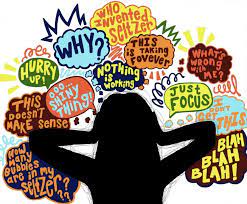
As a meditator, it’s easy to get down on your brain. At least for me it is. The brain is so proficient at distracting and entertaining and protecting you from yourself, from knowing yourself, from perceiving reality. The brain doesn’t think you can handle it. The brain wants to make to-do lists and analyze episodes of Succession and replay interactions with your boss and even wax on about the benefits of meditation – as long as it doesn’t have to shut up an meditate.

Oh, Brain.

Despite its many shortcomings, the brain is a glorious, creative, plastic, infinitely complicated organ. It can even be put to excellent use in service of liberation, freedom from aversion and attachment.

Marvelously mundane case in point:

I was hunting for the remote control in order to watch my kickboxing video, and found it on the couch, along with a guacamole lid, three balled-up paper towels, a lighter, and several crushed corn chips. I threw it all away in frustration born of repetition and futility. After exercising, I made myself a sandwich and, reaching for a plate, found bowls stacked on top of them. I then went for the cheese slicer and found it in the wrong drawer. Frustration bordering on anger again.

Before you start identifying with my plight, let me color in this sketch.

My partner is afflicted with significant ADHD. His everyday life made a sharp turn for the better once he was finally prescribed treatment in the form of a Schedule II drug. It improved my life, too. Particularly in his willingness to engage in various activities, errands, etc. But he can’t take the drug every day, for fear of addiction, and he still struggles with completing tasks that most of us non-ADHD folks do without thinking, or with minimal effort.

The problem from my perspective, as the partner of an ADHDer, is not knowing what I am allowed to expect and what I am allowed to get pissed at. What is reasonable when interacting with someone whose brain does not work the way mine does? When am I being unreasonable and when is my compassion being exploited (if unintentionally)?

And how can I help him? I got him a Tile, an alert that can find his keys, wallet, and phone. But other than that, there’s really not much I can do. And that is very hard to accept. We’re conditioned to believe that correcting someone’s actions will produce a change in behavior, but our conditioning is based on a certain type of brain functioning that simply doesn’t apply to everyone. We find that hard to believe, so we look for an explanation we can control: they’re lazy, they’re being deliberately intractable – mal intent is more welcome than an inexplicable inability to do things the way we want them done.

I’ve tried to moderate my expectations. As long as the bowls are in the right cabinet, even if it’s the wrong stack, I won’t get annoyed. I can let go of not composting the ubiquitous paper towels, if he at least throws them away. As long as I can find all the shower stuff he moves when he takes a bath, there’s no reason to mention it.

Reasonable, right? I mean, right?

I felt the spark of an alternative as I tossed the couch garbage this morning. Hang on tight; it’s a doozy.

What if none of it upset me?

What is the fucking point of all this aversion?

If I thought it would do any good, it might make sense to hold onto some of it, just long enough to bring it up with him. But we’ve lived together for almost a decade. We’ve been over and over these things. Most of this stuff is a weekly performance. Why do I bother? I don’t mean that in the shaming, irritated sense. I mean, literally, why am I getting bothered about this bullshit?

Yes, I’d rather not have to pick up garbage, and rearrange dishes and utensils and such, but getting bothered about it doesn’t make it any more pleasant. In fact (you know it!), it always makes it worse. If the task is actually difficult to do, I can ask him to take care of it, absent the tone of frustration or resentment that creates more pain for him, which inevitably creates more pain for me. The only justification for the anger has been refuted above. I know it’s not deliberate and I know it’s not antagonistic. I know he cannot correct this with grit and determination. But some part of me still wants to believe there’s a logic to it, something I can fix. I can’t fix it, or him, or anything. I can just do what I do, and try to do it without attachment to outcome.

Does it seem impossible? It’s not. If you have a young child or a dog, you organize their everyday chaos without inflicting guilt or preaching, because you accept both their guilelessness and your role as caretaker. There’s no reason we can’t extend that to everyone. It’s just a matter of letting go of what doesn’t serve you. I don’t like getting pissed off about this bullshit. I know that. I don’t like being a nag. I know that. In these situations, there’s no reason not to stop causing myself and others pain. Stop clinging to the way I want things to be; stop freaking out when they’re not.

See? Brain sees problem, Brain traces cause, Brain remembers 4 Noble Truths, brain proposes practical solution.

Yay, Brain!

We’ll see if it can stick the landing. I’ll keep you in the loop.

Responsibility v Fragility

white liesI don’t believe in free will. We can argue that another time. Right now I’d like to briefly discuss what this means when confronting issues of white supremacy and racism.

Denying free will does not mean denying responsibility. Certainly, one could choose to use it in that way, but that’s not my bag. Within the given framework that my actions are the culmination of everything – universally, politically, genetically, environmentally – that has led to the moment in which the action was taken, I still acknowledge some kind of “me” who understands ethics and feels compassion and has a history and as such, I am responsible for my actions. I am where I am because of the circumstances that have led me here, but now that I’m here, I am part of everything that has contributed to my current state. If this doesn’t make sense to you, I get it. I can’t explain it in a way that even I can fully defend, but it is what I believe.

Similarly, White people must accept responsibility for racism, even though their position of power, their privilege, and their ignorance may not be consciously chosen. We are where we are because of white supremacy, and we have hurt people with our words and our actions, inevitably. Taking responsibility means different things for different people, but I do think it must include recognition of current, pervasive, devastating and dangerous racism, and our complicity in it. For most of us, that means talking about it.

The White producers of the podast White Lies say that in their home state of Alabama, all the White people they tried to interview about racism and the Civil Rights movement said they’re tired of talking about all that. When asked when they did talk about all that, what deep, soul-searching conversations led to all this exhaustion, of course there was no answer. Because they have never talked about it. White people are worn out from all the conversations they’ve never had.

I’m not mocking them. It is exhausting. Carrying the collective knowledge of the shared White guilt of centuries of oppression is fucking exhausting. But the weight isn’t lessened by avoiding it. Talking about it, accepting our participation in racial injustice, actually does help. I have been talking about race for a while now, and I am here to testify, folks, that you can build White Racial Stamina. Can I get a witness! I’m not as fragile as I used to be; I can (sometimes) accept responsibility and recognize my complicity without emotionally devastating shame. It’s an endless journey, but I’m definitely further along the trail than I was even a year ago.

I am a living part of a living world, and just as there is no impenetrable barrier between my organs and the environment that keeps them functioning with Oxygen and water, there is no impenetrable barrier between my actions and the actions of the history that led to me. Breathe it in, clean it up, exhale the waste.

Tu Cancer es Mi Cancer

You have a friend with cancer, let’s say breast cancer because it seems both more common and less scary than others (just lop it off, right?). It was caught early and it seems like she’s going to be fine, if breastless. She’s not, like, your best friend, so this isn’t a direct hit on your life. But she’s close enough that you can’t dismiss it as another inevitable, anonymous cancer story. You truly care about her. You bring food and offer support and “like” or “cry” or “anger” all her facebook posts. You are not a Bad Person.

But she’s not what you think about at 2am, staring at the ceiling. You think about You. Specifically, You in contrast with her. You start to construct a questionnaire, like those at the doctor’s office that tell you whether you’re an alcoholic. Yours is something like this:

  • Are you older or younger than her?
  • Did she smoke? Do you?
  • Is she nicer than you?
  • Does she drink? A lot? How much less than you?
  • Would you describe her as a “positive person”? Are you?
  • What’s her medical history? How healthy are you?
  • Does she meditate? for how long? Does she seem enlightened? More than You?
  • Does she exercise? What kind?
  • Where did she grow up? Was it on a nuclear test site? Wasn’t there a paint manufacturer around the corner when you were a kid? Was this before they banned lead? Why don’t you ever see those neighbors on facebook!?

And you think you can take all your answers and hers, give them each a number, calculate a cancer score for each of you, and objectively determine whether you are more or less likely to get cancer than she is. Then think of ways to dramatically derail your life so you can beat those odds.

But it’s all bullshit. This is the story we tell ourselves. It’s a lot like our success story, our ideas of the right and wrong things to do to lead us to the desired conclusion. It’s magical thinking, and it’s utterly unhelpful. It saps energy and presence and eats away at you. Of course there are proven behaviors that should reduce risk, but that’s not what this is about. This is about constructing a story against which you can praise or blame yourself and chart your future – a way to give yourself control over something that is essentially out of your control.

Crafted after your scary health diagnosis, this magical storytelling is worse than unhelpful, it’s destructive. Blaming yourself for your affliction is, first, untrue (because there is no free will, folks – your cancer is the product of your genetics, the block you grew up on, the people you’ve known, and the behavior of every atom in the universe which crafted your inevitable journey toward every single thing you’ve ever done); and second, it’s adding insult to injury. Even if you do believe you were responsible, what does that matter now? It helps nothing. The post-diagnosis should be all healing and living and decision making and all that fun shit. When it comes down to it, Your Cancer is not about you and your concept of self. But even more than that, Her Cancer is not About You.

Get off it. Be a friend. Get over yourself. I mean, it’s normal to think this way, but stop now. It’s totally normal to turn your friend’s cancer into your rumination fantasy, right?

There’s no way I’m the first one to do this, right?

Hello? Is this thing on?