(Started this post during the pandemic & abandoned it. Thank you, Alan Arkin, least of all for getting me to complete a post again.)
Years ago, I watched a long interview with Alan Arkin while on the treadmill at the gym. I know I was on the treadmill at the gym because I generally avoid interviews with actors, but the viewing choices on the guy tv were limited to soap operas, reality tv and this. I would say I have nothing against actors, but that’s not entirely true. Having been one, I kinda feel like I’ve had my fill of actors’ opinions. Totally unfair, I know. Actors’ opinions are just as valid as anyone else’s; I think I’m mostly bothered by the widespread belief, in this country at least, that fame makes you wise.
But Alan Arkin is a phenomenal actor, so I was willing to give him a bit of my attention. (Being talented makes you wise?) I only remember one thing he said, but I’ve remembered it for over a decade. I believe he was answering a question about working on Catch 22. He said something like, “of course we had a good time. We were making a movie together. How lucky are we? I find it so upsetting when I hear that The Beatles were fighting when making Let It Be, that they were angry and didn’t want to be there and hated each other. I mean, they were the most popular band of all time making some of the best music ever. If people can’t enjoy that, what hope is there for the rest of us?”
Please don’t hold me to the accuracy of that summary. I’ve likely made up 90% of it in the many times over the years I’ve recalled it.
Accurately or not, it stuck with me.
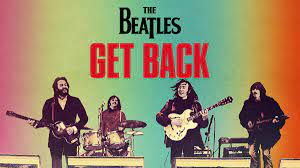
So, yeah, I watched all of the nearly 8 hour documentary series, and it was revelatory for me in many ways.
I first saw Let it Be as a kid. The Parkway Theatre in Chicago would show double or triple features all the time, and I’d frequently go for a cheap day out with my sister or my mom. They were typically grouped by theme – Westerns, horror movies – or creator – a Marx Brothers day, a Charlie Chaplin day, a Beatles day. I saw Let it Be when I was still in the single digits, and had a child’s view of the adults in the film: adult men at the end of a long, successful career. That was the first illusion pleasantly shattered by sitting down to the documentary tome. When was this made? I asked The Guy (a Beatles fanatic). “1969.” Wait, so how old were they?
Ringo Starr was 28 when they recorded Let it Be. George Harrison was 25.
They were fucking children.
I had always remembered Let It Be as The Beatles in their 40s (as kids typically inflate adults’ ages), starting to settle down, ready to move on. While the latter may have been true, they were doing so with almost the entirety of their adult lives ahead of them. It must have been terrifying, the thought of walking away from the most successful musical act ever, the only thing you’d done as an adult, to see what else was out there. I think this can explain a lot of the tension and conflict that did exist in the crafting and recording sessions, though it seems, in the Get Back documentary, that tension was wildly exaggerated.
So many spiritual lessons can be taken from this. I’ll start with the most obvious: the reality presented to you by another person is only their reality, or the one they’ve chosen to present. It is not Truth. I’ll extend that to say that no one’s reality is the ultimate reality; reality is only the perception of reality. There is no secret actual reality untouched by perception or context. The effort to approach an unbiased picture of an event is important and admirable, but reaching that objective goal is impossible, just as perfection is impossible. Nothing but the ultimate Truths are truth, but that doesn’t mean we don’t keep striving towards a compassionate, comprehensive perspective. Get Back is not Truth, either, but in giving us more time with the band and their collaborators, we have more space to form our own truth. It is less curated and far more ambiguous; there are fewer heroes and villains and far more people involved.
But that’s just the beginning of the wisdom Get Back has to offer, folks.
First, and oh-so-illuminating for me, for me particularly as a writer, and not a collaborative one: the generosity and egolessness with which all the band members gave of their work, asked for help, offered suggestions, admitted frustration was just fucking gorgeous. The song and the quality of the song is what matters, not whose name is on it (or not so much). Maybe this wasn’t a big deal to you, but people raised by parents/siblings/etc. with narcissistic traits often have a greater need for approval – the approval is a measure of the self worth – so giving up credit or allowing others to contribute to something I do, with or without credit, can feel like failure. To just keep on giving and giving up like Lennon, McCartney, and Harrison do – I hope I reach that level of maturity someday. Both John and Paul later said they could never write as well without the other – that they “filled in the gaps” as Rocky so brilliantly described it.
Second, because it has to be said, is how little Yoko had to say or do with anything. She basically just sits there next to John whenever she’s around. Now to my tastes, that’s a little clingy and intrusive, but the intrusiveness never seems more than physical, and honestly the others in the band don’t seem bothered by it. Lots of people stop by during the recording sessions, and sometimes they’re right in the mix as well. As for her distracting qualities, Paul excuses John’s frequent guest and occasional disinterest with the patience of an elder: John’s in love and wants to spend time with Yoko. Again, this isn’t a middleaged, grizzled man who’d found someone to carry him through his twilight years – John was a young man in a new relationship.
Speaking of love, McCartney married Linda Eastman later the same year, and the mutual love and joy between him and his soon-to-be-daughter Heather is impossible to ignore. In so many ways, McCartney seems like the father of the group, moving them forward, bearing responsibility, and negotiating conflict with far more care and maturity than I can typically muster.
But to the point I started on, Alan Arkin, and most of us, had the wrong idea, cultivated from the previous documentary. These men clearly cared about each other, but beyond that they really enjoyed working together. They had fun. Playing songs over and over and over, they have fun; performing in front of an audience (if safely distanced), which they’d avoided for years, they had fun. Messing with lyrics and music and each other, they had fun. Joy is generative.
back to 2023…
I was, as Alan Arkin must have been if he joined us in this viewing experience, so happy to see how these guys actually were with each other. To see how much they clearly loved each other, and others. And to see the creative process – how they worked together and made suggestions and fucking played together. I don’t know that I’ve ever been in a space like that. Maybe some of those really good Steven Book improv classes – but that was at best, like, 5 minutes a week. These guys were grooving for months. And you do see the love, and patience, and forgiveness – that’s what most of it is. The animosity was the exception, as far as you can tell from this EXTENSIVE recording. The album did come out of love, and the performance on the roof was, just as you can see in the photos on the album, full of joy (and cold).
Can you create beauty out of hate? I suppose someone might toss up anti-war art or paintings as works of hate. But even if you look at Guernica or Wilfred Owen, those are works of love – love of the lives devastated and obliterated. The hate is a byproduct of the love. I’m not sure where you go with a band like Oasis – clearly great pop songs from miserable, hatefilled people, but is it beautiful? The Hare Krishnas, among others, believe that the state of mind or spirit with which the food is prepared becomes part of the food, so you should only prepare food with love and joy and eat food created in the same spirit. So also with art? I think, mostly? Give me anyone’s artistic inspiration and I can probably find a way to turn it into love, but that doesn’t mean I’m right. Is revenge art, heartbreak art, guilt art really out of love for what was lost more than hatred for what was left?
I suppose there are no absolutes. But art and joy and love feed off of each other more often than not. As much as I support the financial goals of SAG/AFTRA and the WGA, art is not about money. Money is a vehicle to support the creation of art, and generate more love and joy and understanding in the world.


 There’s lots of talk about The Real You in meditation and Buddhism. Your true self. Try to imagine “you” without your history, your preferences, your intellect, your opinions, your habits, your neuroses, your body and all that’s associated with it. What have you got?
 You know how all those hippy-dippy new-agey pro-therapy weirdos are always saying you can’t really love someone else until you love yourself? I’ve always said I believe that, but to be honest, I never really understood the logic behind it. That started to change last winter, when the weather crept into my heart and I was filled with … I wasn’t sure what, but it manifested as anger, my fallback emotion. I was blowing up more than I have in years – particularly at Ben & the Dog. And while the specific trigger for my anger was at times a legitimate complaint, it did not justify the intensity of the reaction. Being, let’s say “blessed” with self-awareness and apparently benefiting from years of daily meditation (maybe? a little?), I didn’t revel in feeling angry the way I used to and I knew there had to be a personal reason for it.
  No angst to report, readers.
  clawing my way to enlightenment