In Spanish and other languages the parts of the body aren’t possessive. It’s la mano, la cabeza – not my hand, my head. In the meditation practices I follow, we are asked to do the same with thoughts: noting “thinking;” not “I’m thinking”. Most helpful for me: labeling sensations in a disinterested manner. Not, my foot’s numb, my knee hurts, but pain is being experienced. That’s a bit long for me, so I tend to go with pain is happening, boredom is happening or numbness exists, tension exists. It’s a deliberate method not to defer the feeling, but to universalize it. When we attach to our pain, it isolates us – whether it sets us apart as uniquely victimized or uniquely ignored, it sets us apart. When we use our pain to, if subtly, acknowledge the experience of pain everywhere, at the very moment that it’s manifesting in us, it has the opposite effect of opening us up to the world and our place in and with it, and simultaneously, if subtly, transforming our interpretation of the sensation or emotion from something negative into something that simply is.
In one of the books on dying that I’ve consumed (maybe Atul Gawande’s Being Mortal), a man who had lost his oldest son to a genetic condition in his late teens was asked how he got through that tragedy, how he could stand losing a child, he simply said, “He was a wonderful person, and it was an honor to have known him.”
This response, or my memory of it, has stuck with me for years. It comes up almost every time I think about the death of someone I care about – past or eventual. There’s so much in this simple answer. I think it struck me first because it didn’t seem like a response to the question asked. (Something I tend to notice because of my ridiculously literal approach to conversation.) No judgment! I mean, look what this guy had to suffer through. But in fact, it is an answer to the question, and there’s no suffering in it. He “gets through” it because it’s a privilege, it’s a gift. While I have no doubt that this man himself felt as much pain as any of us would in losing a child, it’s not about him. It’s about them as a mutualistic partnership, of shared love.
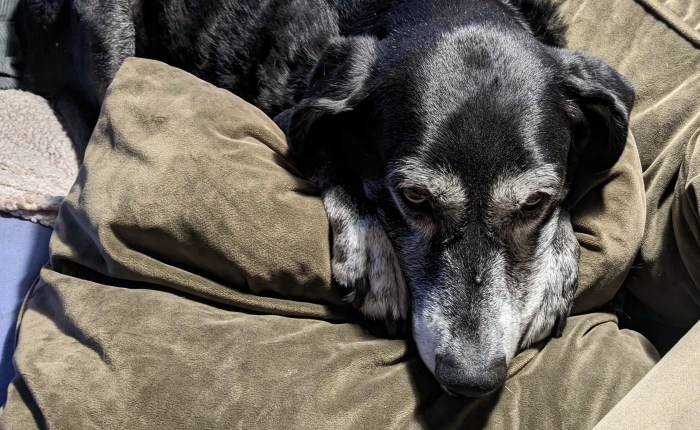
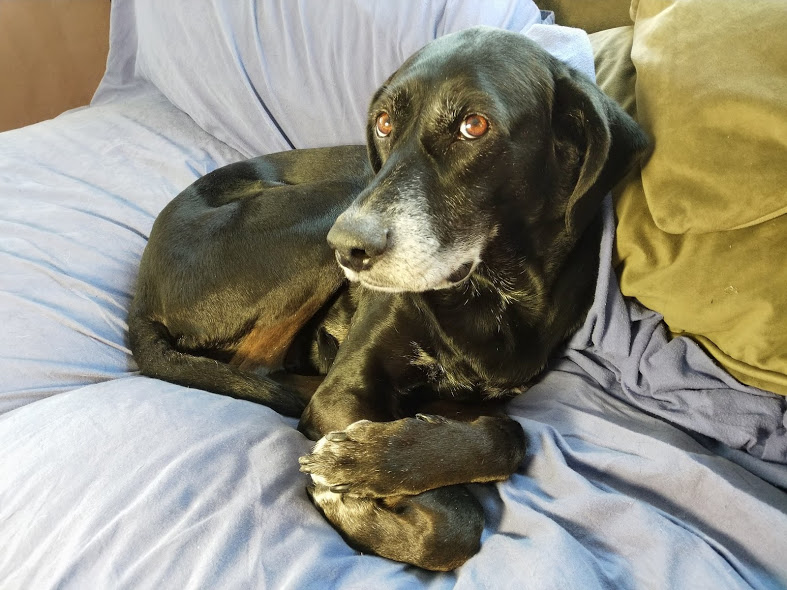
Our dog, Vicious, is old. Not crazy old, but she’s outlived the average lifespan of her major breeds, she’s quite deaf, and she has issues with her back legs (alleviated by some great drugs – science!) B & I both struggle with our fears of losing her. I see it in him and myself, whether we put it into words of not – the way we stare at her when she’s sleeping, the excessive concern when she simply trips or gets up a bit more slowly than usual, the occasional moment of panic after being particularly delighted with some weirdness of hers. When I joke that “it will kill us when she dies” I’m not joking. A part of us – individually and collectively – will die, and something else will likely replace it – the shared sadness, the shared loss, the shared history. I’ve had to talk myself down many times over the past year or so … finding myself obsessing about losing her, working myself up into a frenzy, and then confronting myself with the simplest, most obvious truth, one I’ve been studying for nearly two decades: be here now, bitches. And instead of lying in bed thinking about her being gone, I go downstairs and cuddle her on the couch – whether she likes it or not (she’s neutral). Sometimes it’s hard for us humans to truly understand why living in the future is such a waste of time; it’s so much a way of life that it doesn’t seem harmful at all. But when confronted with a future loss it becomes so fucking clear. I can experience the pain of losing her once she’s dead, or I can torture myself by experiencing the pain even longer! Right now, when I could be appreciating her! Awesome!
Of course we can’t stop ourselves from thinking about the death of loved ones, especially if they’re old or ill, but if we can redirect whenever we catch ourselves – just like coming back to the breath in meditation – life is so much better. We can’t prepare ourselves, emotionally, for tragedy. We can make practical plans, whether logistic, financial, what have you, but the pain you feel when they’re gone will not be lessened one iota by the anxiety you invested in the loss beforehand.
So that’s helped. But then there’s this additional element introduced by that incredibly equanimous parent. The thing that strikes me most about his response is his detachment – not from the experience, but from ownership. It wasn’t that is was his son, his loss: his son was a person in his own right – a wonderful person – who he was honored to know. As I’ve been mulling this over in relation to V, it’s amazing how much spaciousness it gives me. When I think of her as my dog, she begins and ends with me, with our introduction to her existence. But when I think of her as the highly specific, weird freak that she is – one born before I knew her and perhaps inhabiting some kind of consciousness before then; one who has moved countless people and been idolized by the occasional dog, one who will continue to live on in all of us, in our memories and the feelings and experiences she inspired – (in exactly the same way she lives on now when I’m not in her presence), one who makes choices and has preferences unrelated to me or what I want of her – then losing her is painful, devastating, but not catastrophic. She will have left us, but she hasn’t left. Everything dies, but nothing ever leaves. We are all literally made up of the same particles that existed at the beginning of matter as we know it. Vicious is just a sedate, introverted, tolerant, yardwork-loving, floppy eared version of a particular collection of elements and, if you believe as I do, a particular manifestation of consciousness. This understanding won’t make me any less sad when she dies, but when I think about her inevitable departure from that perspective, I feel less suffering, less individual attachment to her and more, like that enlightened father, a feeling of unbelievable luck. I got to care for this exceptional creature. I got to spoon her in the morning; I got to stare into her beautiful brown eyes and wonder what she thinks when she looks into mine; I got to watch her prance like a horse and chase turkeys and lie in the sun with her eyes closed and her head in the air. Particularly knowing when I took her in that she would, barring some anomaly, die before me, how can I regret her loss? If I see her as a visitor, as a gift, it’s all good. Everything is impermanent. Everyone leaves us, or we leave them. It’s all just a matter of how much presence and gratitude I can bring to her right here, right now (when she’ll let me).
If we can do this with our loved ones, it may be a better way of honoring their existence, their journey on this planet, and help us let go a little more easily when they leave.
(I write this now, of course, because I won’t be able to write it when she’s actually gone, but I may be able to read it).
 There’s lots of talk about The Real You in meditation and Buddhism. Your true self. Try to imagine “you” without your history, your preferences, your intellect, your opinions, your habits, your neuroses, your body and all that’s associated with it. What have you got?
 clawing my way to enlightenment