Start Where You’re At: Mitt Romney?

Start Where You’re At: Mitt Romney?

Holy hell, it’s been hard to blog this year. I don’t know whether to blame the additional State Fair job, the suckiness of my regular job, the world as it is, or just the natural ebb & flow of being human, but the longer I’m away the harder it is to come back. Do I try to wow you with some heretofore hidden epiphany? Catch you up on my life? (yawn) List all of the spiritual accomplishments I’ve acquired in 2023? (ha!) Nah. Here’s what caught my attention today.

I pedaled over to the DMV this morning (they don’t call it the DMV in Minnesota, but fuck that: it’s the DMV) for a relatively painless Real ID appointment and plugged into Fresh Air’s interview with the author of Mitt Romney’s bio for the ride. Like many, I am intrigued with the recent revelations from the ageless Mormon, and have been mildly impressed with the integrity he’s maintained during his Senate terms. He has a family history of doing the right thing: as HUD Secretary, his father attempted to deny federal funding to communities that were de facto racially segregated, before Nixon shut him down (check out the This American Life segment if you want more on that). And voting for impeachment was impressive, especially considering the bodyguards he’s been personally paying for ever since.

Anyhoo, what my Buddhish perception found most intriguing about the interview was Romney’s bemusement over the self-imposed enslavement of most Senators to the US Senate. In his words, the chamber is “a club for old men” whose “psychic currency” as a human is built on the foundation of Being a US Senator. Not just that their job is important to them, but, for most of them, their identity is their job. The decisive question when making a vote is “will this help me get reelected?” He said he has tried to reason with them, to use himself as an example: that failing to win the Presidency as a major party nominee was about the biggest loss one could imagine, and he came out okay. But clearly, most of these guys are not like Romney. And many of these guys are not okay.

I’ve occasionally been confused by the contortions some Republicans have made to twist their lips onto Trump’s ass. I try not to assume that people are evil, so I look for motivation behind actions that are incomprehensible to me. Why even be an elected official if you don’t have issues or policies you care about? Why remain an elected official if you’ve caved on everything you purportedly did care about? Why play lackey to a narcissistic fool who would sell you out and put your life in jeopardy just to generate more likes on Twitter? You could probably make a lot more money in the private sector (especially once you’ve held office). And they don’t do it only because they fear actual retaliation – these spineless humanoids were selling out before Trump had the power to literally rally unhinged fans to attack them. In fact, it was the Republican party’s utter prostration to Trump that helped forge the mob of the unhinged that we’re all grappling with today. Is it just the lust for power? Maybe, but how much power do you actually have when a volatile, infantile, failed businessman controls your every move?

I think it’s something else. What Romney has that most of his old, White colleagues do not is an apparently real commitment to his form of morality, apparently from the Mormon church. It’s hard for me to believe that the guidance I receive from Buddhist practice & dharma is anything like the “spirituality” others glean from conservative religions, but I have to admit that my disbelief comes primarily from ignorance. There are countless fucked up things about the mainstream Mormon church (though far more about FLDS – hoo-boy!) but there does seem to be some idea of integrity built in, and clearly Romney’s religion and family stand outside of, preceded, and will supersede his role as a Senator. His sense of self is not chained to that, or any, title. Instead of getting an apartment in DC or living with other Congressmen, he bought a townhouse off the strip in the hopes his wife and kids would feel more comfortable visiting. What I’m trying to say in way too many words is that there is more to Mitt’s life than winning, and maybe if winning is all that matters to the once-and-oh-please-never-again-President, then caring less about winning, by converse illogic, is … good?

The bush I’m pummeling here is this: morality means something to Romney, something more than having power or winning an election. He believes that he has a higher obligation, and that has apparently kept him from caving like the others. This is a bit hard for me to say because it’s in pretty direct opposition to what I used to believe (as most things are these days – FU, Buddha!). When I used to hear that people were supporting candidates “of Faith” or because they were “right with the lord” or “Christians” I was always horrified. What does that have to do with policy? Don’t you want to know their positions? Isn’t that incredibly arrogant and presumptuous to think that someone will be a better leader just because they believe in your God? And while I still agree with most of that, I now understand the reasoning behind it. Well-meaning people may well believe that Christians – or Whatevers – will be better politicians because they will not be unduly swayed by what is convenient or popular or least risky – they will be guided predominantly by what their understanding of morality. When (some) people vote for candidates based on faith, they aren’t voting for the issues the church favors, but the spiritual guidance that leads to those positions. Political issues and proposals change all the time, but the basic moral foundations of the religion (wildly varying in interpretation, of course) presumably don’t.

I can accept that that’s actually not a terrible way to cast a vote. I mean, politicians lie and change their votes all the time, but if you really believe that they are guided by a strong moral compass – one that you also believe in – then you don’t need to worry about the vagaries of politics. They’ll always look into their God fearing hearts for the best decision. I doubt this holds up for most supposedly religious politicians, but I do get the theory behind it. If Roshi Joan Halifax or Lama Rod Owens or Thich Nhat Hanh were running for office, I wouldn’t need to know what they thought about any issues (though I can guess), because I know they believe in nonviolence and interdependence and universal compassion. So I can’t condemn others for following the same thinking.

On the flippity-flip, that’s the fucked up thing about Evangelicals and Trump. He has NO ground. There is literally nothing in this world Trump cares about except himself, specifically feeding his gluttonous ego. And yet, Evangelicals supported him because policy decisions that were expedient for him coincided with their own. It’s the opposite of what they’ve done in the past and still do with other candidates. They weren’t tricked into believing that Trump was a Christian; they’re not idiots. All his playacting just gave them a little cover for what they really wanted: someone who would shut down everything that went against their specific, contemporary political priorities. They took the path of nonbelievers and voted on policy alone. And it worked for them, at least on the surface. They got their ultra-conservative Supreme Court, at the very least. But if the tide had turned, if it does turn, and somehow Trump’s supporters shifted – if he were to become the hero of socially liberal, Israel-loving Jews, and believed they would propel him back into office – Protestant evangelicals & Jew-hating White Nationalists would be dumped naked on the side of the road. Supporting an amoral, petulant manbaby is a pretty huge risk for a contingent that believes the soul of our country is at stake.

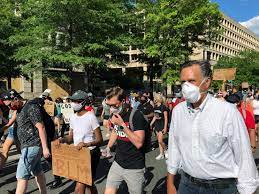
Listen/look/feel me, I have always voted based on candidates’ political positions. If a few folks supported pretty much the same stuff, I might look at other factors. If someone comes off as a condescending asshole or has a plethora of rumors swirling about personal issues, I might reconsider; but I helped run a city council campaign for a guy who treated me worse than any boss ever has in my life. Despite the humiliation, I stayed because I thought he was the best candidate. (No, I’m not proud of that decision and do not encourage anyone to do the same.) But if I could truly look into the heartmindsoul of each candidate and vote on that, I might go the way of the spiritually-driven voter. I know people questioned the sincerity of Romney participating in a Black Lives Matter march back in 2020, but if that generated any votes, it was far less than he lost in standing up to the Republican party, so I have to trust his sincerity. And appreciate it.

Of course, of course it doesn’t have to be religion. It can be personal integrity, responsibility to one’s community; even true patriotism (a concept that scares the shit out of me) has occasionally been enough to withstand Trump’s infectious poison (e.g. General Mark Milley). But without any foundation in love or faith or ethics or responsibility (Have you no decency, Sir?), without any motivation other than holding office, holding office ceases to have meaning and those who do it simply bend with the prevailing winds. The Republican party is run by a hungry ghost protected by sentient doormats, and as long as they have power, the voices of the (yes, infinitely too conservative for me but still somewhat) decent members will be drowned out and ultimately disappear.

Application Essay for Enlightenment

Okay, that’s a little misleading. I am starting a year-long training on Socially Engaged Buddhism next month and was asked to submit an essay on why I am participating and the social justice work I do. Here’s ’tis:

I think of myself as a philosophical and spiritual Buddhist. I’ve been meditating regularly for a decade. I don’t practice any religion, but I’ve read enough (mostly Western) Buddhism to feel I have a grasp on what it’s offering, and what I’ve understood resonates as true – that clinging and aversion create suffering, that putting shoes on your own feet makes more sense than trying to carpet the world, that emotions should be felt and acknowledged, but not sanctified or given a leadership position; that the vagaries of the world can’t hurt you much of you can get to a place where you recognize your own learned, egocentric, knee-jerk bullshit.

At the same time, I write and talk and facilitate discussions on & occasionally protest about race and racism and I know how important it is for Black people, in particular, to have space where they can express anger after hundreds of years of being forced to counter a false stereotype and actual threats to their lives for having genuine emotional reactions to abuse. And I think it is important to hold the country and individuals accountable for causing pain, even when it’s not intentional, or at least not consciously so. And in theory, at least, these seem to stand in opposition to my Buddhist beliefs.

As a pseudo-Buddhist (or Pseu-Bu) and a former door-to-door fundraiser, I believe in “assume good intent.” I know how the expectation of rejection creates negativity in a very real way. But I totally understand and have defended the reasons why that is not always possible, and perhaps not even best, when confronting White people’s harmful words and actions; that it may be important for White people to experience the pain that has grown out of their complicity in White Supremacy. Maybe it’s just fine that they feel discomfort when faced with the consequences of their actions, intentional or not. Maybe the best thing isn’t always the kindest thing. I get all that. I don’t even object to BIPOC folks acting out of anger, as long as it’s not violent.

But I only accept this behavior b/c it is a reasonable response in an unreasonable world & a racist, genocidal, cruel, unfair country. If those circumstances did not exist, these behaviors, while perhaps educational and cathartic and rightfully disruptive, would simply be creating more suffering.

I am not saying I need to reconcile these – one of the big hallmarks of White Supremacy is either/or thinking, and Eastern philosophy seems to allow space for apparent contradiction as well. But I want the support, I want better understanding of the foundations of my beliefs, and I would like to be able to understand, defend, and articulate them well (and from a place of love).

I also don’t think everyone has to agree or have the same role in social justice movements. Folks can have myriad approaches to activism. While I believe hate is the wrong path, that acting in anger is only the right move by accident, that sucker punching a White Supremacist during an on-camera interview or screaming Fuck the Cops is ultimately counter-productive, that doesn’t mean those things are wrong in every context or that there may not be a place for them. Some people oppose violence in any circumstance, whereas I believe in self-defense and protecting others when necessary, especially for women, people with disabilities, & BIPOC folk. I respect complete non-violence, but for me it isn’t always the right path. One of the things I love about the Buddhism I have studied is that there are no absolute rules. I love the story of the (as I remember it) Buddhist monk on the ship who kills the murdering pirate who tries to take over, not only to prevent the inevitable loss of life, but to save the pirate himself from further self-torture.

In part, I’m looking for spiritual and philosophical reinforcement. And to better trust myself to make the right decisions for me. And to have patience and love for my fellow White liberals when they typescream “if you’re not outraged youre not paying attention!” and “if this doesn’t make you cry you don’t have a heart!” The policing of and sublimation of emotions is such a quick, easy, cold, infantilizing approach to dismissing our fellow humans.

I know that the best practice is meditation practice, and if I could take a bullet train to enlightenment and drop that ego, I probably wouldn’t even need this. Short of that, I am hoping a better, intellectual understanding and community and education will help me speak and perform my own truth – not without a willingness to change, but without shame or fear of confrontation and challenges from groups I feel compelled to defer to.

I live in Minneapolis, less than 2 miles from where George Floyd was killed. I attended the first protest and several cleanups and more protests and volunteered at the memorial and food shelves and attended online discussions about race with folks who were just setting foot on the path I’ve been traveling for decades and wrote and facilitated and taught about inequity and White Supremacy, and while this all sounds frantic & thoughtless, it was & it wasn’t. I knew this real, yet manufactured urgency was temporary. I knew I would “git my Buddha on” and transition to thoughtful, spiritually integrated action in the near future. I was relieved beyond expression when I stumbled across and attended a Love Serve Remember weekend months ago which gave me the spiritual strength to get me through the election, another path where I had given in to just doing masses of whatever until I crossed that finish line, and planning to re-center myself afterwards.

So I stopped attending unhelpful (to me) conversations on whiteness and race, sent my 100 postcards to Georgia, and allowed myself a breather at the end of the year. And one day this training showed up in my gmail. My only hesitation was the expense, but even that didn’t last long. It looks like exactly what I’m looking for – a grounding in reality and connection and a shift away from white guilt and white supremacist behaviors like urgency and perfectionism doing over being.

This very piece is practice in moving away from perfectionism, which for me blares most loudly in my writing and editing. A dog walking injury of a broken wrist makes it difficult and a bit painful to type, so I won’t be editing this to my usual standards. I am trying to let go of the idea that you (without even knowing who you are) will therefore like me less at the get-go (insert nervously smiling emoji here).

Have I answered your questions? Perhaps not entirely. Racial justice is obviously my main focus, and writing and facilitating are the main ways I focus, but I also work on food justice, and occasionally climate change, disability rights, and other issues, and am open to doing more work as I feel I can.

And with a deep breath, I dive in.

Thanks for reading,

Defunding Police & Seeing Clearly

IMG_20200606_152227604Two hours ago, the Minneapolis City Council voted, in a veto-proof majority, to Defund the Minneapolis Police Department. This will be a hasty post, but I’m just sooo excited, friends!

I have never been so proud to be a Minneapolitan. Today, I add this label with pride to my geographic identities of Chicagoan and Angeleno/a. There is no city I would rather live in right now. Real change is resting in our hands; not just in policing, but in community resilience and care and connections and in our way of thinking.

As a pseu-Bu* meditator, this week has been an inspiration. Sure, some of the folks who I marched with yesterday may have been anti-police across the board, or anarchists, or willing to swallow whatever the most radical voices were saying, for better and worse, but some of us have spent decades living in cities, witnessing corruption and brutality and racist policing, and yet have not imagined, until recently, that there was any other way for us to be. Getting rid of the police sounded as crazy as getting rid of capitalism, or personal car ownership, or one of the many other exciting ideas on the horizon that now seem possible.

BECAUSE IT IS ALL POSSIBLE.

One of my favorite things about Buddhism is the commitment to see what is really in front of you, without preconceptions or embedded beliefs; letting go of ideology and history to see what is really there. And we old (over 30) folks who were willing to look at the problem differently, to consider the evidence and recommendations that had been put before us by younger, less White, more revolutionary people, really did do something significant.

We changed our minds.

If you’ve studied the way the brain works, this is really not easy to do. And while we are not by any stretch the heroes of the Defund movement – that label goes to Reclaim the Block and MPD150 and many other brilliant and tireless activists, it will take those of us who are plugging along, doing our best, wanting to help, all the clearsightedness we can muster to support the changes that are coming. How do we reimagine policing? What can we actually do to help? How do we think of crime? And punishment? How can we build a beloved community where people help each other instead of anonymously calling an outside, armed force to intervene when we have problems? How can we see these as our problems? Loosening our grip on the way things have always been, our beliefs, our fears, will all be necessary in the new world to come.

I am so excited, I can hardly stand it. I just want to throw my arms around everyone. Love and peace and resilience to all.

*pseudo-Buddhist

Does Anti-Racism Work Make You Sexy?

Followup question: Do I have a future in clickbait?

sexyI had a lovely day today. Nothing special. I had planned to spend most of the day writing and reading, but instead wiled away the hours interacting with folks and art. My journey began at a too-popular bread n breakfast place. Tables freed up one at a time as I anxiously waited for a place to plant my incipient biscuit sandwich. A 4-top opened up when I reached the front of the line, and I took it a little guiltily, checking to see if a nearby twosome was getting up anytime soon so I could swap out my spot. Continue reading “Does Anti-Racism Work Make You Sexy?”

Personal Non-Violence

punch(There may be a related “political non-violence” piece in the works, but that will have to go on the race blog. By the way: upcoming Race Blog!)
Since Trump’s electoral college win, we seem to have embraced more violence as a country. Not just the lunatic fringe of proud racists and anti-Semites, but also the liberal Left. Let’s call this the “punch a Nazi” philosophy, as it shone most blindingly after a video went viral of Richard Spencer being socked in the face during an on-the-street interview.

Many Facebook Friends loved this. Facebook Friends who didn’t were called racist or stupid or ignorant by fellow White Liberals. I didn’t get involved, because I’m allergic to commentdebate, but I watched reasonable people get taken down and shut down en masse.

I am not pro-violence. I think it’s bad for the perpetrator and the victim, and almost always creates more pain and suffering than it prevents. But not always. I am not a pacifist. I admire pacifism, but I am not a pacifist. At least, I don’t think so. One can only know one’s true stance when forced to defend it. Maybe I could look with compassion and kindness and forgiveness on someone who hurt me, but at this moment, I doubt it.

I believe in defending myself. I admire those who make a conscious decision not to – Jesus and his ilk – but I am a woman who has been physically assaulted and I believe in fighting back. Not just to avoid pain, but to show the attacker that women are not walking targets and hopefully discourage him (yeah, I think I can assume Him) from hurting another woman. If I were a man, particularly a physically imposing man, I could see how turning the other cheek might be illuminating as well.

I also believe in defending others. I would hope that if I saw someone being attacked, or knew an attack was imminent, that I would try to prevent it. It seems more likely that this would manifest as getting between than taking on, but I’m not opposed to physical action in this situation, either.

And I think that’s it. So if Richard Spencer (heretofore referred to as Fuckwad) were an actual Nazi: killing, deporting, and enslaving Jews, homosexuals, etc, I could justify personally taking up violence against him. But only – and this is the crucial element of my philosophy – if it did some good. You might say that Fuckwad promotes racism and anti-Semitism and slavery (which the fuckwad does), and that therefore he is a justifiable target, but does targeting him do any good?

Here’s where the pro Punch a Nazi contingent loses its rational footing. I get that you want to see Fuckwad punched; I get that you might want to punch him yourself, but punching him accomplishes nothing. I know many anti-Fuckwad folks laughed and cheered when they saw the video, but it did not accomplish any of the following things:

  1. embarrass him: he recovered calmly and smoothly, in a civilized manner, saying he’d taken a hit before, and continued with the interview
  2. hurt him: see above
  3. prevent him from spewing his calm vitriol: see above
  4. turn any of his followers in another direction: Fuckwad presented either as an innocent victim or as the masculine “man” they love to – platonically! – love. Plus, the attacker may appear irrational, violent, and animalistic, playing into the lie Fuckwad and team have crafted.
  5. move any anti-Fuckwads to worthwhile action: posting about how much you love violence against people you don’t love is not worthwhile action, not if you want to make the world a better place, as you purport to do

I cannot think of one positive thing the sucker punch accomplished, other than, perhaps, making me more wary of liberals. I guess that could be a good thing. If you can think of a positive impact, please let me know. Maybe there’s something I’m not seeing.

Pseu-Bus (soo-boos)* like myself probably shouldn’t say this, but one could better justify killing Fuckwad than punching him. I don’t condone that, either, but it would have shut him up. There’s a tiny, tiny chance that might have done some good in the world, though it’s really unlikely. If he were The Creator of these ideas, or the only public figure still promoting them, then yeah, removing him might dramatically weaken the support for those ideas; but he is far from the first and far from the last, and disabling him would more likely bring about a martyrdom than a dissolution of support. Again, let me be clear: I’m not endorsing this, I’m just saying it holds more water than the punching defense. No one wants to go back in time to “clock Hitler a good one.”

I am not a pacifist because we don’t live in a perfect world and I do think there is a place for violence. If we let go of our egos and reactive anger, that place would be really, really remote.

Beyond that, violence is not my role in the world. There may be a place for violence in the activism that is necessary to save an environment or society worth living in. But every movement has numerous roles – speakers, writers, artists, event planners, even bodies. Don’t look to me to be the muscle. I am an overly compassionate wuss. It breaks my heart to see footage of the losing bench in a finals game, even if it’s the Patriots. It breaks my heart to think of a dog waiting for its dead owner to come home, even if the owner is Fuckwad. I have never felt good after saying something mean to even a vicious, loathed person. Not if they seemed hurt by it, and if they didn’t, then what was the point? I lose either way. Right Speech and Right Action in Buddhism aren’t just about protecting the world, they’re about protecting yourself.

I guess what I’m saying, dear reader, is I am not the resource for all your Nazi-punching needs. I can’t take on that role until it’s the only role left.

*Pseu-Bu: pseudo-Buddhist; in my case, someone who has put together some semblance of a Buddhist philosophy based almost exclusively on contemporary Western interpretations of Buddhism.

Memorializing

holocaust walk
Holocaust Memorial in Germany

I don’t have a problem with the annual memorializing of 9/11. But last month marked the 400th anniversary of the beginning of slavery in the US, acknowledged only by some segments of the press and small memorials here and there. It would have been easy to miss it entirely. It makes me wonder what we commemorate and why.

I’ve been listening to the White Lies podcast, which is ostensibly an investigation into the murder of the Reverend James Reeb, beaten to death after joining the movement for voting rights in Alabama. But really it’s an examination of the South, and culpability, and how we lie to ourselves in order to absolve ourselves of responsibility. It’s not just the South that excels at this. Our country loves to forget the horrors we’ve committed. Unless we’re turning our crimes into victories, which is a specialty of the South. As is the “memorial as fuck you.” Not just Confederate statues deep into the 20th Century, but a statue of the Klan’s first Grand Wizard a week into the term of Selma’s first Black mayor. In 2000.

Perhaps this makes sense to you. A country doesn’t want to rest on its mistakes and crimes, it wants to celebrate its achievements. It wants to encourage pride and patriotism. So we remember “good” things we’ve done and times when we were victimized, but not anything for which we were responsible, in which we fucked up. But I keep thinking of Germany and the ubiquitous reminders of the Holocaust. There is another way to do things. It might help our understanding of history and mitigate our arrogance if we acknowledged African slavery and Indian genocide in the same way.

Of course, Germany made reparations to Jews. I don’t know if they could memorialize if they hadn’t. How would we feel in this US if we were constantly reminded of those crimes against humanity, while simultaneously recognizing that the structural racism and oppression continue. Someone might want to do something about it. Who knows where that could lead.

Then again, right wing racists are on the rise in Germany, too, so maybe nothing does any good.

Now I’m in a bad mood.


400 Years Ago (+ several days)

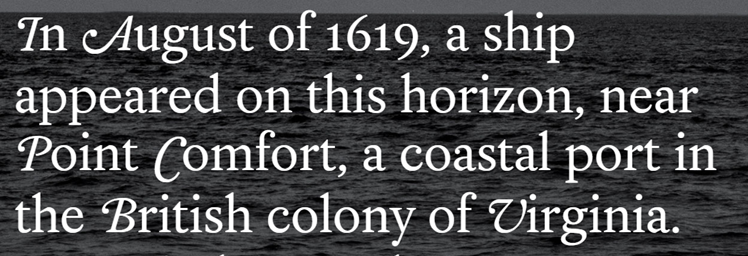
1619I was going to post about how my critical self likes to take stock of my failures at the end of every season, but I think the cute, self-deprecating, sad overview can wait. Because where I really fucked up was in not writing about the 400th anniversary of the beginning of slavery in what was to become this country by what were to become the admired White settlers of Jamestown, in colonial Virginia. You can look it up. The image above and quotes that link to excellent work are in the NY Times feature, The 1619 Project.
Slavery is not a blight on this country’s fine history; it is not a shameful period of time with a beginning and an end. It is this country. The United States is a country of brutality and greed, where we have always put profit above people. Our government has had to be forced, by disruption and death and citizen disgust, to make every expansion of human rights that we have grudgingly, eventually agreed to. Maybe that’s the way it always happens. I’m not enough of a student of history to say for sure. But when I read that Trump’s “least racist person in the world” line is about as close as he’s ever come to accurately quoting Thomas Jefferson, who repeatedly insisted that, “nobody wishes more than I” for abolition, while enslaving Black people and profiting financially and sexually from their exploitation, should I really be surprised? Should I be shocked that the legacy of slavery infects our very language? Should I not expect that our country would lead the way in pushing humanity towards extinction?

There is some debate that the Anthropocene (the geologic era of human influence) would more accurately be called the Capitalocene (the geologic era of capitalism), because it is not humanity that has warmed the planet to the point of crisis, but carbon-fueled capitalism. And what is capitalism but the pursuit of financial gain at the expense of everything else? (But the invisible hand, you say, what about the invisible hand?? The invisible hand is, in my view of the moment, nothing but an excuse to pursue wealth uninhibited by ethics. You, capitalist, don’t have to worry about whether what you are doing is wrong, because the market will correct you if it is. Look at the world and tell me that isn’t bullshit.)

But the heedless racing toward mass extinction is only one example of our culture of slavery. Capital punishment is another. As is mass incarceration. Bryan Stephenson (maybe the new Buddha/Jesus?) writes in the above 1619 feature, “Slavery gave America a fear of black people and a taste for violent punishment.” A country of slavery would also be expected to hurl barriers in the paths of non-white humans trying to seek safety therein; to use food and deprivation as weapons; to deny health care, etc. The idea that those lucky enough to buy themselves a good life have somehow earned it is as backward and unscientific as the belief that Europeans are of a different and superior species to Africans.

Slavery is an economic system in which countless lives are destroyed in order to fill the treasure chests of a few, and those lives are vilified in order to justify the destruction. Whether smearing the victims as racially inferior, lazy, greedy, better off, ignorant, foreign, stupid, dirty, insignificant, or violent, it’s all the same. It’s all a way to make brutality palatable and selfishness noble. And it will destroy, if not all of us, then certainly the lifestyle that it has created.

I’m feeling despondent today, but not depressed. Yay for me! Boo for you.


this is just a link to a thing on the Amazon

I’m not up for writing today, and this is the time I have to write. Sorry, folks. I’m going to make tomorrow’s lunch, read some more Stamped from the Beginning, and leave you with this characteristically excellent piece on the ravished Amazon from the vlogbrothers: https://www.youtube.com/watch?v=zhESYHHbzsc .

“There has never been a greater reminder that nationalism is a disaster of an ideology.”

Minnesota White

mnniceLast night was the last night of our 6 month, once-a-month, Unpacking Whiteness exploration at the Zen Center. I honestly got more out of it than I thought I would, and when we went around the circle to give a brief comment on our reaction to the process as a whole, mine was that I was surprised how much I learned from the White people in my group: that I’ve been exploring this topic for a while, unlike many of the participants, and hyper conscious of race my whole life, unlike (based on what they’d said) nearly all of the other participants, and I wasn’t sure I’d get much from the others in my little circle. But every week someone brought up something I hadn’t thought about, or hadn’t been able to put into words, or hadn’t been brave enough to confess to, and I deeply appreciated both what they gave me and the hope they gave me for the potential of other White people. Not that this group of Zen meditators is representative of all White people, but still, I’ll back pocket that optimism.

After we had all said something, anyone was welcome to pick up the talking piece and say whatever they were inspired to add. I didn’t think I had anything else, but a few people’s comments sparked (another!) revelation, and I decided to share.

So many Minnesotans I’ve spoken to talk about never having had Black friends, about having grown up in an entirely White community, about having no relationships with people of color, and it occurred to me that the very culture of Minnesota may in fact be racist.

I doubt that is the main reason why this state is still so white. I would but the biggest blame on the racial covenants that are just now coming to light, the people harassed out of their homes, the lynchings in Duluth, etc. But if you look at Minnesota today, how welcoming is it to people who aren’t White, Christian, and Mild? Minnesota Nice isn’t just about passive aggression and passing politeness. It means you made all the friends you’ll ever need in 5th grade, and there is no reason to let strangers into your life. It includes complaining about things to everyone except the people who can do something about it. It means not talking during a movie, but also not having the huevos to tell the person who is talking to be quiet. It means glaring at the person who laughs too loud; and calling the person at work who answers an emailed question directly, without copious smileyfaces and explanation points, “rude.” It means an inordinate amount of people who do not like to be touched, a preference I’d never before encountered. It means that social anxiety can go undiagnosed, because that’s just how people are here. If you are physically expressive, people think you are dramatic. If you are physically affectionate, people think you’re an artist. Or gay. (You probably are.)

I brought this up at work a few years back, when we were talking about culture. (This was before I was brave enough to bring up the fact that we were entirely avoiding a discussion of race.) Nobody was volunteering an answer to the HR Director’s question, so, like many before her, she went to me, because she knew I’d have something to say. I don’t really have a problem with that, except for that fact that in this workplace it is sometimes used against me. But fine. I decided to grab the spotlight and broach the issue of Minnesota culture.

Being indirect in speech, being passive, continually deferring to others is perceived as “normal” here. I know I am perceived as different or bold or whatever because I express opinions when asked, because I sometimes reveal what I know to be true, because I have the gaul to disagree with someone in a meeting where we are supposed to be giving feedback on a topic. You think this perception is normal, but it is not. It is cultural. My behavior was not unusual in Chicago or Los Angeles. It may have been slightly less typical for a woman, but it was not abnormal. You think it is abnormal because people do not typically behave that way in Minnesota, but your standard is not universal, and people who don’t follow that standard should not be Otherized.

Despite the reality that what I actually said was far less coherent, I had several people approach me in the days after that training to express how I’d opened their eyes. It was kind of stunning.

So my revelation last night was looking at this culture through a racial lens and finding even more that was unwelcoming. If I, a run of the mill middle-aged White woman, perceive this culture as repressive, what kind of impact does it have on various people of color? People who might culturally express themselves through spontaneous song or dance? People whose religion is built on argumentation? People who express trust and affection through touch? People who laugh loudly and look for friends across borders? So the Jews plant themselves in St Louis Park and surround themselves with other Jews. And then the Hmong came. And the Somalis. And they also tend to plant roots in neighborhoods that cater to their own culture. And why wouldn’t they? I don’t blame them, and I don’t think it’s all about the language or affinity bias. Minnesota, even Minneapolis/St. Paul, is dominated by a White, Christian culture in a way that Chicago and Los Angeles were not. Yes, the uber-culture in the US is always White, but there was too much of a mix of folks in LA & Chicago for any one cultural standard to dominate. I can’t define either of those cities by culture. When people do single something out, it’s usually an aspect of White culture, like the hippie laid back Californian, but that’s never representative. Minnesota Nice is far more accurate.

So it’s not just the poor transportation and the ridiculous rental  prices that keep the Twin Cities from becoming Manhattan. It is our culture of Whiteness and Christianity. It’s oppressive and it is inherently exclusive. And it keeps these goodhearted meditators from having Black friends and Latino neighbors. It makes me sad, but recognizing something concrete always inspires me because concrete can be broken up. I felt inspired when I broached this in the circle last night. I thought it was another eye-opener, another way in which life could be improved for everyone. Something else we could work on!

But no one talked to me afterwards. No one thanked me for this awesome peek behind the curtain. No one openly agreed with me. Of course, that may be because I headed straight for my Chacos and walked out right after I helped put chairs away. I’ve never felt entirely welcome in the Zen center, and that also makes me sad because I set admittedly high expectations for Buddhist communities. Too much ceremony & formality for my comfort? Too little magical ability on their part to reach past my defenses and psychically will me to stay and commune? Aren’t they all enlightened already?!

yeah.probably my own weirdness.

Citizenship

naturalizationI wasn’t going to write anything about the impressively racist Trumpeet that grabbed the headlines this week. What is there to say? I don’t have a broad audience – everyone reading this feels more or less the same about it; everyone recognizes the xenophobia & ignorance & historical resonance.

But a months-old note to myself and another exceptional On the Media interview have given me a bit more insight, so I thought I’d share. Continue reading “Citizenship”

Responsibility v Fragility

white liesI don’t believe in free will. We can argue that another time. Right now I’d like to briefly discuss what this means when confronting issues of white supremacy and racism.

Denying free will does not mean denying responsibility. Certainly, one could choose to use it in that way, but that’s not my bag. Within the given framework that my actions are the culmination of everything – universally, politically, genetically, environmentally – that has led to the moment in which the action was taken, I still acknowledge some kind of “me” who understands ethics and feels compassion and has a history and as such, I am responsible for my actions. I am where I am because of the circumstances that have led me here, but now that I’m here, I am part of everything that has contributed to my current state. If this doesn’t make sense to you, I get it. I can’t explain it in a way that even I can fully defend, but it is what I believe.

Similarly, White people must accept responsibility for racism, even though their position of power, their privilege, and their ignorance may not be consciously chosen. We are where we are because of white supremacy, and we have hurt people with our words and our actions, inevitably. Taking responsibility means different things for different people, but I do think it must include recognition of current, pervasive, devastating and dangerous racism, and our complicity in it. For most of us, that means talking about it.

The White producers of the podast White Lies say that in their home state of Alabama, all the White people they tried to interview about racism and the Civil Rights movement said they’re tired of talking about all that. When asked when they did talk about all that, what deep, soul-searching conversations led to all this exhaustion, of course there was no answer. Because they have never talked about it. White people are worn out from all the conversations they’ve never had.

I’m not mocking them. It is exhausting. Carrying the collective knowledge of the shared White guilt of centuries of oppression is fucking exhausting. But the weight isn’t lessened by avoiding it. Talking about it, accepting our participation in racial injustice, actually does help. I have been talking about race for a while now, and I am here to testify, folks, that you can build White Racial Stamina. Can I get a witness! I’m not as fragile as I used to be; I can (sometimes) accept responsibility and recognize my complicity without emotionally devastating shame. It’s an endless journey, but I’m definitely further along the trail than I was even a year ago.

I am a living part of a living world, and just as there is no impenetrable barrier between my organs and the environment that keeps them functioning with Oxygen and water, there is no impenetrable barrier between my actions and the actions of the history that led to me. Breathe it in, clean it up, exhale the waste.

Cops & Fear

policeWhat does it mean to be afraid?

You’ve probably heard about the recent murder verdict in Minnesota. If not, here are the facts: a cop was convicted of second degree murder in the shooting of a civilian. It is the first time a police officer has ever been convicted of murder in Minnesota. Of the 98 officers in the US arrested for on-duty fatal shootings in the last 15 years, only 4 have been convicted of murder. And here is the context (you saw it coming): the cop convicted of killing Justine Ruszczyk, a White woman, in Minneapolis, was Mohammed Noor, a Muslim, Somali, Black cop.

Both Noor and Yanez, the cop who killed Philando Castile in 2016, said they feared for their lives and shot to defend themselves. I don’t doubt that for a second. Have you heard the video of Yanez? He’s clearly terrified. I have no particular reason to think either of these men had any desire to kill anyone, ever. But why is fear a justifiable excuse for shooting a civilian while on duty? And why only sometimes? Prosecutors in fact mocked Noor’s fear on the stand, asking, “The whole blonde hair, pink T-shirt and all is a threat to you?” Kind of sickening, right? Implying that a black man in a do-rag would have been a real, or at least a reasonable threat.

I’m not saying cops shouldn’t be afraid. They should be human. But they should also be held to a higher standard. Anyone licensed to carry and discharge a deadly weapon on the job should be held to an incredibly high standard. Every attempt should be made to draw out and minimize all implicit biases. Extensive mindfulness training should be mandatory, to keep them from reacting on base, baseless instinct. Instinct itself should stop being treated like some kind of gift and recognized for what it is: a reaction based on a lifetime of accumulated experiences, traumas, observations, and media input, supplemented with evolutionary impulses and only occasionally informed by the reality of the given situation. Is it okay to be afraid of a black man shooting a gun at you? What about a black man holding a gun? A black man? A black child? A black child running away from you? When does it stop being acceptable to justify violence with fear? Why is violence accepted as a reaction to fear? I could be scared walking down a dark street at night in what I perceive to be a bad neighborhood, but that doesn’t give me the right to kill anyone who approaches me. A black man could be scared when he’s pulled over by a police officer because he sees people like him being killed on the news with horrifying regularity, but that doesn’t give him the right to kill the officer when he approaches his window. It doesn’t even give him the right to run away from him.

I don’t pretend not to understand the elevated circumstances in which cops work, the unimaginable stress in dangerous areas, and the threats they often do encounter, but this fear defense is so fucking grey it seems to have no precise meaning at all. If they’re that afraid, they shouldn’t be cops. Or they should be treated for that condition before they’re on the street. If their training itself is telling them to be that afraid, the training is fucked. Maybe my barely thought out alternative is ridiculous, but it’s not unprecedented. Mindful police training is quietly happening around the country. It has the potential to help the officers live better lives and improve the outcome in all of their interactions.

I’m going to call toxic masculinity out in this one. What else could be the source of the belief that compassion and reason and equanimity and thoughtfulness are bad qualities in a person for whom a deadly weapon is an office supply? Or is it capitalism? The American Way? So many destructive ways of thinking.

I like the idea that there are only two emotions: love and fear. I don’t know if that’s accurate, but it makes sense that the more you love, the less you fear. If law enforcement can stop seeing love and compassion as enemies of the job, there might be less enemies of the job, and they might be able to actually, effectively, serve and protect all the people in their community.

The 1A, Lizzo, Jordan Peele, and other things that scare white supremacists

key & peeleWhen we were asked, in our April Unpacking Whiteness circles, to talk about the ways in which white supremacy had hurt us (White people) the first thing that came to mind was my favorite NPR shows. I didn’t share that the group, in part because I was determined to let my answer be spontaneous once the circle came round to me and in part because, let’s face it, Capitalism is a more impressive answer than “Joshua Johnson.”

But I love Joshua Johnson. The 1A Friday news roundup has become my favorite news show, because of him. He brings on excellent reporters, from a variety of backgrounds, and they have real discussions about issues that matter to me. What sets it apart are Joshua’s humor and facilitation skills, his incorporation of cultural events, and the fact that he’s Black. A lot of the issues most prominent in my purview today are issues I’d just rather hear broached by a Black journalist (police shootings, reparations, Trump, economic inequality). And honestly, it makes me feel better hearing a Black man calmly discuss and laugh at the insanity of the world than it would a White man. It’s essentially meaningless when a White man laughs at the state of the world, because White men have pretty much always benefitted, whatever the swirling chaos around them. (I’m sure some of you believe we should not allow ourselves to laugh at the world, but I am not engaging with you on this. I get it, but you are not going to seduce me over to your side of the fence.)

But it’s not just Joshua Johnson, or Sam Sanders of It’s Been a Minute, or even the “Barbershop” segment on Weekend All Things Considered, where Michel Martin bounces the news of the week off of knowledgable POCs. It’s also the pure, off the chain joy of Lizzo, the cinematic depth of Jordan Peele, the all-around genius of Donald Glover, the breathtaking, brutal honesty of Claudia Rankine.

We have been fucking ourselves, people.

We’ve been looking at ourselves and our world with one eye closed for so long. The oppression of Black people has deprived all of us of inestimable riches. Some have always managed to claw their way through the muck and shine against all odds, but what would we have been privy too if all odds weren’t against them? What would we be blessed with now if the playing field had been equal?

We can’t just blame those who’ve shamelessly, openly worked to keep Black people down, whether through racial covenants, incarceration, strict White social standards, general dehumanization, etc. The “see no color” philosophy that was a big part of my childhood culture implicitly excused the exclusion of Black voices because we were “all the same.” You could have (and some definitely have) done the same with race theory: concluding that since race is a construct (true), drawing distinctions between races or calling attention to race as it exists today is meaningless (not true). Hell, everything we know is a construct. From the Buddhist perspective, there is no difference between me and the chair I’m sitting on. We draw distinctions because we need them to function (if I am the food, can I eat the food?) and we draw more and more complex identities in order to function in a human society. And the final, most visible glaze in that creation is the identities that society imposes upon us. They may not be permanent, but they are absolutely real.

My background is in theatre & literature, but I have never thought arts & culture so important as I see them today. So much of that is because of the way life as a Black person, particularly a Black person within a Black culture embedded in a White country, is being artistically expressed today, and particularly in popular media. What might have changed if Atlanta, Insecure, Blackish, and Empire (created by Black people) were all on TV when I was a kid, instead of just Sanford & Son, Good Times, and The Jeffersons (created by White people)?

William Faulkner wrote this in a piece on desegregation in 1956:

The white man knows that only ninety years ago not one percent of the Negro race could own a deed to land, let alone read that deed; yet in only ninety years, although his only contact with a county courthouse is the window through which he pays the taxes for which he has no representation, he can own his land and farm it with inferior stock and worn-out tools and gear — equipment which any white man would starve with — and raise children and feed and clothe them and send them North where they can have equal scholastic opportunity, and end his life holding his head up because he owes no man, with even enough over to pay for his coffin and funeral.

That’s what the white man in the South is afraid of: that the Negro, who has done so much with no chance, might do so much more with an equal one that he might take the white man’s economy away from him, the Negro now the banker or the merchant or the planter and the white man the sharecropper or the tenant. 

Segregation, racist policies, and the history of slavery are still defining features of the United States, and POC are still thriving in spite of it. It’s hard to imagine how much farther along we might be as a country and a species if we had extended full citizenship to everyone, ever. That’s the funny thing about white supremacists. If they really believe in the superiority of the “White Race,” they should be the biggest advocates for levelling the playing field, in order to prove their point. I don’t see a whole lot of that going on.

More Moments in White Awareness

I’m attending a once-a-month, 6 month Unpacking Whiteness discussion series at a local Buddhist centerI signed up hoping to uncover an unbreakable bond between Buddhist philosophy and racial justice, where I often find conflict, at least on the surface.

More on that at some point. For the moment, I’ll just say that it has not served that purpose, at least not yet. And Yet, it has been enlightening in a different way. I wasn’t thrilled with the first session, but introductory meetings tend to be pretty thin. Most of the people in my little group hadn’t spent much time thinking, and less time speaking, about their own Whiteness and Whiteness in the world, and I facilitate those discussions whenever I can, so I was metaphorically twiddling my thumbs for much of the March meeting.

But this week things got good. By which I mean, they got vulnerable.

We started by going around the room and each sharing an act of historical racism committed by White people, preferably in Minnesota. I liked that everyone was instructed to phrase it as White actions, rather than Black or Brown or Red victimization. As in, “a mob of White people lynched three young Black men in Duluth in 1920” (fact) rather than, “three black men were lynched in Minnesota in 1920.” The passive voice is a powerful way to excise blame. I was intrigued by how many of the responses focused on atrocities committed against Native Americans. I don’t think that would have been the case in my hometown of Chicago. For better or worse, Minnesotans have more awareness of what they have done to Indians than what they have done to Black people. Many people think Black people just chose not to live here because it’s so cold or White; whereas, even if they can’t tell the story, they know Whites screwed over the people who lived on this land before us.

There were then two questions assigned to our small groups. How have you benefitted from White privilege and how have you been harmed by White privilege? The answers to the latter were particularly interesting. I honestly had no idea how I was going to respond, allowing me to, for once, answer pretty spontaneously. Everything I said bounced off of some excellent point a previous participant had made. Whether it was the shame I carry for being White; the feeling that any Black person would be crazy to trust me or any White person with real friendship; the fear of asking POC real questions about race because I know they’ve been burdened with the reality their whole lives; the oppressive White supremacist system of Capitalism and how it engenders competition, and constant dissatisfaction, and environmental destruction, and exclusion. (I highly recommend you have this conversation with a group of friends or open-minded strangers. Or in the comments below. I’d love to hear what you come up with.)

Our final task was to go around our breakout circles and say a few words about how we were feeling. One of the Zen priests, who happens to be in my group, said he felt terribly sad about the feelings of separation from POC that everyone had touched on. But I had to honestly say that I was both relieved and excited. Relieved that I had brought more muck to the surface, and excited at the prospect of embarking on disinfection. I don’t know how yet, but you can’t change what you can’t see.

Bribery Ain’t The Half of It

USCLook, I’m as grossed out as anyone over the bribery & deception scandals that have been unveiled in the past week, and I’m happy to see these people of privilege (POP) get indicted. But this is just one example of the much larger issue of inequity in education in the US.

There’s nothing novel in that statement, and maybe that’s the problem. We treat inequity like it’s an innate, intractable fact of life and are rarely horrified by it. Continue reading “Bribery Ain’t The Half of It”

The Truth and Jussie Smollett

nooseJussie Smollett is telling the truth. Or telling a truth. Or telling us something truer than the truth.

“A thing may happen and be a total lie; another thing may not happen and be truer than the truth.” Tim O’Brien, The Things They Carried.

O’Brien wrote about war, the unfathomable experience of war. He believed that the facts, the truth, were insufficient to depict his experience, to get his message across, to transmit the horrors of being a soldier in Vietnam.

If that is unfathomable, how can we who are not possibly fathom the lifelong, manifold experience of being a Black, gay man in the United States? Continue reading “The Truth and Jussie Smollett”

Elizabeth Warren’s Identity Crisis

pocahontasI started writing this a year ago, and I had hoped I wouldn’t need to post it, but here we are with a seemingly decent public figure digging her own political grave in a desperate, nail-ripping grasp of identity.
I’ve never met the woman, but here’s my outsider analysis. (Factcheck-free!)

Elizabeth Warren was brought up on a story both romantic and empowering. Told that one of her ancestors was ostracized because of her Native American heritage, and was loved and married despite that (wholly unacceptable!) racism, Warren wove the story into her own identity from the time she was a little girl. And who wouldn’t? Hell, I cling to my genetic half-Judaism like it’s the last lifeboat on the sinking ship of white supremacy. What thoughtful, educated, observant white person would want to be White? I mean, we want all our stuff and political and economic supremacy of course, but we also want to claim some history of oppression, some feeling of done-wrongedness that will act as a palliative to our privilege. Maybe we can balance out a little of our imperialist, murderous, slaveowning genes with a sprinkling of the “good guys.” Maybe we can find some African genes in our 23 and Me results (nope, just more Mongolian: Khan slut). But for many the ultimate prize is Native affiliation, especially in the US.

I went through a big Indian phase – read tons of Native books (mostly novels), bought Native jewelry and knicknacks, spent a lot of time traveling Navajo/Dine country in the Southwest. Because Indians are fucking cool, man. We simultaneously embrace these conflicting concepts of Native people in the US: the drunken, uneducated, poverty-stricken people living on pitiable reservations; and the wise, equanimous souls who understand silence and the universe and our relationship with the natural world. They have potions and spirit animals and songs and dances and secrets and wisdom. Who wouldn’t want a piece of that?

So a white woman clings to that family story, as do her relatives, reinforcing it across generations. But when it comes down to it, it’s just a story. One that she repeats and uses officially and unofficially for decades.

To what end?

I can believe that she wasn’t looking for affirmative action or special treatment because of it, I really can. But she wanted something. Was it just a little less guilt? A little less complicity? A little more grooviness, man? Whatever it was was her own business, her psychological drama to bear, until Trump got hold of it. Then it became our problem.

Because Warren has taken a leadership role in Congress. She has stood up for the little guy, the disenfranchised, the poor, and stood up to the archetypal “white man.” Despite the inability to sound human and genuine when she makes a speech (an affliction that seems to infect nearly every living politician, usually forever; somebody get these people an acting coach!), she had potential. And I’m not writing her political death warrant, but she has wasted much of that work because of some bullshit concept of her racial identity.

As soon as her Native claims were brought into the light of day, she should have had the sense to come out and say, “look, this is a story my family was brought up on, and I’ve had a hard time letting go of it, because the Native peoples in this country are so special, I have so much respect for them, and I so wanted to be identified with them. But I have no tribal affiliation and no way to prove this claim, so I am letting it go, out of respect to the people who have suffered the injustices of being Native in the US. I have lived my life as a white woman, with all the privilege (and the prejudice) that goes with that. I will fight for native rights and sovereignty, and against the insults liberally tossed around by the President, as every red-blooded American should, because “Indians” are the true Americans, and all the rest of us are immigrants.

(or something like that)

Then she could just ignore all that Pocahontas shit, with the Indian nations possibly supporting her. Instead, she waited way too long and then tried to reify her fable by taking a DNA test, pissing off the recognized tribes and making herself a joke.

Part of me doesn’t blame her, because I know how hard it is to let go of labels you wear like military honors, or college sweatshirts, but Identity has so much destructive power, from sports fans that can’t let go of a racist mascot to men that can’t let go of abusive machismo. Yes, markers can be empowering or helpful or politically necessary, but if we can’t let go of them when they cause harm to ourselves and others, what good are they? To me, the greatest identity crisis is not trying to figure out who you are, but blindly accepting some inculcated idea of who you are without questioning it. Unfortunately,  most of us never get past that phase.

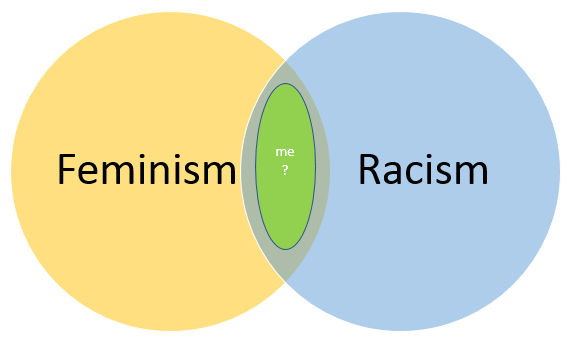
Feminism & Racism: Up Close & Personal

femrac

Some of my feminist behaviors are actually acts of white supremacy.

Damn it.

I’ve been on a Racism Awareness journey over the past year. Well, for longer than that, but aggressively over the past year – reading lots, talking with folks on their own journeys, facilitating conversations on race as much as they’ll let me, going to conferences on equity, volunteering as Secretary on the Diversity Equity and Inclusion Committee at work … stuff like that.

Simultaneously, I have been on a feminist journey: a #me-tooing of my own. This hasn’t required any books, just a clear-headed, clear-eyed recognition of life as it is and has been for me for decades.

My habitual behavior in the realm of the latter is to recognize blatant sexual assault and blatantly sexist language (and in my case to apply feminist analysis to works of literature and art), but to “deal with” the rest as the necessary burden of being female in the world. To play the game, laugh at the jokes, tolerate the piggery. Because we can. Because we are strong enough to do so. Because we can take jokes. (Unlike men. Don’t panic, guys. She’s a professional comedian.) Because we know how to “play with the big boys.” I realized last year that this is not necessarily healthy, and I’m certainly not the only woman doing it. And while I don’t regret behaving in that way, it is a coping mechanism performed out of defensive necessity. I should not have to be tolerant in the face of offense or attack or abuse. I should be able to call it out and have it redressed. That has been a difficult thing to accept, because I take so much pride in my toughness, my ability to withstand sexist bullshit, but in reality it is much braver to upend the game than to play along. I also have to recognize that I have looked down on women who “couldn’t take it,” who chose to make themselves vulnerable by calling out the crap, and I am not proud of that.

It took a bit more formal education and a bit more time to recognize that there was another destructive aspect to the persona I’ve cultivated in response to sexism. I have made it a point to be heard, to express opinions, to speak out at work, to argue and disagree and confront professors because it is my responsibility to fly in the face of stereotypes of female inadequacy and submission and deference. What I never thought to recognize is that while this might be a stand against patriarchy, it’s right in step with the white supremacist culture in which I was born and raised and live.

I have never thought of my assertiveness as consensual with white supremacy, but it is. It’s hard to say what threatens white men more – women or Black people – the threats are different and context is everything – but as a white woman I have certain privileges that Black men and Black women do not have, and I have taken advantage of that privilege more times than I can count. A big one with me is the right to be angry. While I might be described as shrill or hysterical if I openly express anger, I am not perceived as a threat and I’m not usually written off. That is not typically true for Black people in America, because it feeds into the manufactured stereotypes which I certainly don’t need to explain here.

So this idea of standing up to authority, of being what I am in spite of the powers that be: much of that has been an illusion. And coming to terms with that has been … interesting. It doesn’t mean I stop, but it means I bring a little more mindfulness to that behavior. Powerful white men have always benefited from pitting various “others” against each other, but it’s particularly upsetting when we do it without their (explicit) help.

When you start to recognize that we live in a society anchored in the bedrock of white superiority, your perspective on everything changes. The new vista isn’t always pretty, especially when you’re looking in the mirror. If you’re trying to head off another excuse for self-loathing, it helps to recognize that we are all soaking in it, and it takes a lot of work to scrub this shit off.